
Automotive manufacturing automation systems combine industrial robots, control technologies, production machinery, sensors, and manufacturing software to coordinate vehicle production.
These systems support processes such as body welding, painting, component assembly, inspection, material handling, and final vehicle testing. As automotive production expands to include electric vehicles, advanced electronics, and more varied vehicle models, automation technologies are increasingly used to manage complex manufacturing workflows.
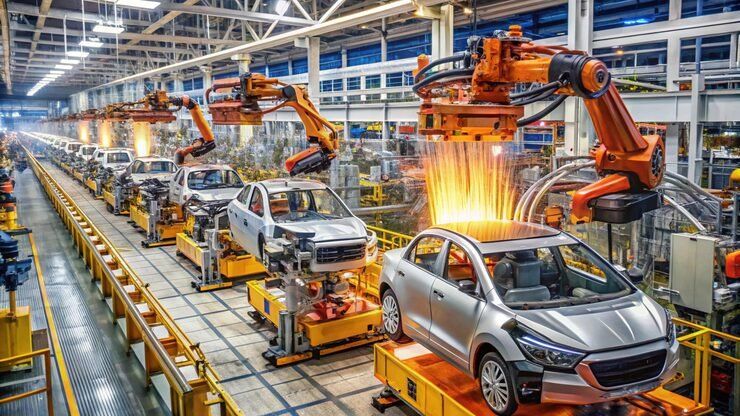
Understanding Automotive Manufacturing Automation Systems
Automotive manufacturing automation refers to the use of machines, robots, control systems, and software to perform or coordinate manufacturing tasks with limited manual intervention.
A modern automotive factory typically consists of several interconnected production areas. Stamping equipment shapes metal sheets, body-in-white systems assemble structural components, paint systems apply protective and decorative coatings, and final assembly lines integrate mechanical, electrical, and electronic components.
Automation connects these operations through programmed sequences, production scheduling, material movement, and quality monitoring. For example, a robotic welding cell can position metal panels, execute programmed welds, and communicate completion signals to a programmable logic controller (PLC). The production line can then transfer the assembly to the next workstation.
The degree of automation varies between manufacturers, facilities, and vehicle platforms. High-volume production may use dedicated automated lines, while factories producing multiple vehicle models may require flexible equipment and reconfigurable robotic cells.
Major Automotive Manufacturing Processes
Metal Stamping and Press Automation
Metal stamping converts sheet metal into automotive components such as doors, hoods, roof panels, and structural reinforcements. Mechanical or hydraulic presses apply controlled force through dies to shape the material.
Automated stamping lines can use robotic transfer systems, mechanical feeders, conveyors, and safety monitoring equipment to move metal sheets between operations. Sensors help detect material position, press status, and certain process abnormalities.
Production planning must account for die changes, material properties, dimensional accuracy, press capacity, and equipment maintenance.
Body-in-White Manufacturing
Body-in-white manufacturing involves assembling the vehicle's main body structure before painting and final assembly. Processes include spot welding, arc welding, riveting, adhesive application, and structural component positioning.
Industrial robots are widely used in body assembly because they can repeat programmed movements and coordinate with fixtures and other production equipment. Vision systems and measurement devices can verify part locations and selected dimensional characteristics.
The final body structure must meet engineering specifications for geometry, strength, and assembly quality. Automated inspection is often combined with engineering checks and other quality-control procedures.
Automotive Paint Shop Automation
Paint shops apply primers, basecoats, clearcoats, and protective treatments according to the vehicle's coating specifications.
Robotic painting systems control the movement of spray equipment and coordinate coating application across vehicle surfaces. Automated systems can also manage conveyors, curing ovens, ventilation, temperature monitoring, and process records.
Paint quality depends on several variables, including surface preparation, coating properties, environmental conditions, spray parameters, and curing conditions. Because coating materials and processes can introduce occupational and environmental hazards, paint shops require appropriate ventilation, fire protection, and material-handling controls.
Powertrain and Component Manufacturing
Powertrain production covers engines, transmissions, drive units, and associated components. Electric vehicle manufacturing adds processes involving electric motors, power electronics, battery packs, and thermal management components.
Automated equipment may perform machining, washing, assembly, fastening, sealing, balancing, and dimensional inspection. Sensors and measurement systems help confirm that selected operations meet specified process limits.
The required automation architecture depends on component complexity, production volume, traceability requirements, and the degree of product variation.
Final Vehicle Assembly
Final assembly brings together the vehicle body, powertrain, suspension, interior components, electrical systems, glazing, and other parts.
Conveyors, lifting equipment, torque-controlled fastening tools, robotic manipulators, and automated guided vehicles can support the movement and installation of components. Manufacturing execution systems may record work completed at each station and associate selected component identifiers with the vehicle.
Human operators continue to perform many assembly, inspection, adjustment, and exception-handling tasks, particularly where operations require flexible judgment or handling of varied components.
Industrial Robots Used in Automotive Manufacturing
Industrial robots are central to many automated automotive production systems. Robot selection depends on the task, payload, reach, positioning requirements, working environment, and required cycle time.
Articulated Robots
Articulated robots use multiple rotary joints to provide flexible movement through a three-dimensional workspace. They are commonly used for body welding, material handling, machine tending, adhesive application, and painting.
Different robot models support different payloads, reach distances, and precision requirements. End-of-arm tooling, such as welding guns, grippers, or spray equipment, must also be selected for the intended operation.
Welding Robots
Welding robots perform repeatable joining operations using programmed paths and controlled process parameters. Resistance spot welding is common in vehicle body assembly, while arc welding is used for selected structural and component applications.
Robot controllers can coordinate movement with welding equipment and production-line controls. Quality verification may include process monitoring, visual inspection, dimensional measurement, and additional testing where required.
Painting Robots
Painting robots move spray equipment along programmed trajectories to apply coatings to complex vehicle surfaces. Their motion can be coordinated with conveyor speed, vehicle geometry, and coating parameters.
Automated painting requires suitable booth design, ventilation, grounding, fire protection, and controls appropriate for the coating materials and operating environment.
Material-Handling Robots
Material-handling robots transfer components between conveyors, fixtures, machines, and assembly stations. They can also support palletizing and machine loading.
The end effector must match the component's size, weight, surface, and orientation. For heavy or irregular parts, engineers must assess gripping reliability, load limits, and the consequences of a dropped component.
Collaborative Robots
Collaborative robots are designed for applications in which interaction with people may occur under defined conditions. Automotive applications can include selected assembly, inspection, and parts-handling tasks.
A collaborative robot does not automatically make an entire workstation safe for shared human access. The complete application—including tooling, workpieces, motion, surrounding machinery, and foreseeable misuse—requires risk assessment.
Key Technologies in Automotive Factory Automation
Automotive production systems combine machine control, motion technology, inspection, communications, and manufacturing software.
| Technology | Primary function | Automotive application |
|---|---|---|
| PLC systems | Machine sequencing and equipment control | Conveyors, assembly stations |
| Industrial robots | Programmable physical operations | Welding, painting, handling |
| Machine vision | Image-based recognition and inspection | Part positioning, surface inspection |
| Servo drives | Controlled motion and positioning | Press transfer, precision assembly |
| SCADA systems | Equipment monitoring and alarms | Utilities, process supervision |
| MES software | Production execution and traceability | Work orders, production records |
| Digital twins | Virtual modeling and simulation | Line design, virtual commissioning |
| AGVs and AMRs | Automated material transportation | Component delivery, internal logistics |
| Industrial IoT | Equipment data collection and connectivity | Condition monitoring, production analysis |
These technologies operate at different levels. PLCs and robot controllers manage equipment behavior, while MES software coordinates production activities and records. Enterprise resource planning (ERP) systems typically manage broader business processes such as purchasing, inventory, orders, and finance.
Integrating these layers requires defined data interfaces, compatible communications, appropriate access permissions, and clear responsibilities for control and monitoring.
Automotive Manufacturing Automation Workflow
Planning and implementing an automotive automation system involves several technical and operational stages.
Production Requirements Analysis
Engineers first examine production volume, model variation, cycle time, quality specifications, available floor space, and existing equipment. They identify bottlenecks and determine which tasks are suitable for automation.
A production line designed for one vehicle platform may differ considerably from a line intended to manufacture several models. Requirements should therefore reflect actual product and process variation.
Equipment Selection and Cell Design
The next stage involves selecting robots, presses, conveyors, fixtures, sensors, controllers, and safety devices. Engineers define robot work envelopes, equipment interfaces, material flow, and access for maintenance.
Simulation tools can help assess reachability, potential collisions, cycle time, and equipment layout before physical installation.
Control Programming and System Integration
PLC programs, robot motion sequences, machine interfaces, and communication networks are configured to coordinate production operations.
Integration tests examine signal exchange, process sequencing, alarm handling, equipment interlocks, and recovery after faults. The design should also define how the system responds when parts are missing, a tool fails, or communication is interrupted.
Commissioning and Validation
Commissioning verifies that equipment has been installed, configured, and tested according to its requirements. Testing may cover normal production, model changes, equipment faults, emergency stops, and maintenance conditions.
Production validation then evaluates output quality, cycle time, repeatability, process capability, and traceability against defined acceptance criteria.
Maintenance and Continuous Improvement
After commissioning, manufacturers use preventive maintenance, equipment diagnostics, spare-parts planning, and production data to support reliable operation.
Recurring alarms, unexpected stoppages, tool wear, and quality deviations can be analyzed to identify improvement opportunities. Changes to control programs or safety functions should follow controlled procedures that include testing and documentation.
Global Automotive Automation Manufacturers and Suppliers
The automotive automation market includes industrial robot manufacturers, control-system companies, machine builders, vision-system suppliers, and engineering integrators.
FANUC
FANUC develops industrial robots, CNC systems, and factory automation technologies. Its products are used in applications such as welding, machine tending, material handling, and assembly.
ABB
ABB provides industrial robots, motion technologies, and automation solutions for manufacturing environments. Its portfolio includes technologies used in material handling, joining, painting, and production-line automation.
KUKA
KUKA develops industrial robots, robotic cells, and automation systems. Its technologies are used in automotive body production, component manufacturing, handling, and assembly operations.
Yaskawa Electric
Yaskawa supplies MOTOMAN industrial robots, servo drives, and motion-control products. These technologies are used in welding, material handling, assembly, and other automated manufacturing processes.
Kawasaki Robotics
Kawasaki Robotics provides industrial robots and robotic systems for applications including welding, handling, painting, and manufacturing automation.
Siemens
Siemens supplies industrial control systems, PLCs, drives, industrial communications, and manufacturing software. These technologies can connect production equipment with monitoring and manufacturing-management systems.
Rockwell Automation
Rockwell Automation provides industrial control products, automation software, industrial networking, and manufacturing operations technologies. Its products are used in automotive production lines and related industrial facilities.
Mitsubishi Electric
Mitsubishi Electric develops industrial robots, PLCs, servo systems, inverters, and CNC technologies. Its products support automated assembly, machine control, material handling, and factory integration.
Machine Builders and System Integrators
Automotive factories also depend on specialized suppliers that design and build stamping lines, welding fixtures, conveyor systems, paint equipment, inspection stations, and complete production cells.
System integrators coordinate equipment, controls, safety systems, and production software to meet project requirements. Their responsibilities vary by contract and may include engineering, programming, installation, commissioning, training, and ongoing technical support.
Supplier evaluation should consider technical compatibility, application experience, documentation, spare-parts availability, service coverage, cybersecurity, and the expected operating life of the equipment.
Automation Applications in Electric Vehicle Manufacturing
Electric vehicle production introduces additional manufacturing requirements for battery systems, electric motors, inverters, power electronics, and high-voltage electrical components.
Battery Pack Assembly
Battery pack production can involve module handling, cell placement, fastening, electrical connections, sealing, adhesive application, and inspection. Automation may also support the controlled movement of battery components between process stages.
Battery manufacturing requires careful management of electrical hazards, material handling, temperature, contamination, and process traceability. Specific safety requirements depend on the battery chemistry, manufacturing operation, and equipment design.
Electric Motor and Power Electronics Production
Electric motor manufacturing can include winding, rotor and stator assembly, balancing, machining, and electrical testing. Power electronics production involves precise component placement, fastening, thermal-interface materials, and functional testing.
Automated inspection and data recording help manufacturers associate test results with specific components or production batches.
High-Voltage Testing and End-of-Line Validation
Electric vehicles require checks of electrical systems, charging functions, control units, and other vehicle subsystems. Automated test equipment can execute defined test sequences and record results.
Testing procedures must be designed for the relevant voltage levels, product requirements, and applicable safety controls.
Recent Developments in Automotive Manufacturing Automation
AI-Assisted Inspection
Artificial intelligence is being applied to selected visual inspection and process-monitoring tasks. Image-analysis systems may identify surface irregularities, assembly errors, or unusual process patterns.
Performance depends on image quality, training data, product variation, and validation methods. AI results should be evaluated against defined quality criteria, particularly where a missed defect could affect safety or vehicle reliability.
Flexible and Reconfigurable Production Lines
Manufacturers are developing production systems that can accommodate multiple vehicle variants or changing component designs. Reconfigurable fixtures, programmable robots, modular equipment, and adaptable material-handling systems can support these requirements.
Flexibility often introduces additional challenges in changeover management, tool configuration, software coordination, and production scheduling.
Digital Twins and Virtual Commissioning
Digital twins and simulation models can represent robot cells, production lines, and material-flow systems. Virtual commissioning allows engineers to test selected control logic and equipment behavior before full physical deployment.
The value of a model depends on its accuracy and how closely it reflects the actual equipment, operating conditions, and control programs.
Predictive Maintenance and Connected Equipment
Connected sensors and machine data can support condition monitoring for motors, gearboxes, robot joints, presses, and conveyors. Data analysis may help identify abnormal vibration, temperature changes, or recurring faults.
Predictive maintenance does not eliminate the need for scheduled inspections, manufacturer-defined maintenance, or safety checks.
Safety Standards and Regulatory Considerations
Automotive automation systems combine moving machinery, electrical equipment, robots, high-energy processes, and human work areas. Safety engineering must therefore cover the complete production system rather than individual machines alone.
ISO 10218-1:2025 addresses safety requirements for industrial robots, while ISO 10218-2:2025 covers the integration of industrial robot applications and robot cells. Both editions were published in February 2025. Their applicability should be evaluated alongside relevant national regulations and other machinery-safety requirements.
Common safety considerations include:
Risk assessment for robot movements, tooling, workpieces, and surrounding equipment.
Guarding, interlocks, safety scanners, or light curtains where required by the risk assessment.
Properly designed emergency-stop and safety-related control functions.
Procedures for isolation of hazardous energy during maintenance.
Training for operators, engineers, and maintenance personnel.
Controlled access to industrial networks and automation engineering systems.
Cybersecurity is also important because unauthorized access to control systems can disrupt production or affect equipment behavior. Manufacturers should maintain asset inventories, access controls, secure configurations, backups, and tested recovery procedures.
Frequently Asked Questions
What are automotive manufacturing automation systems?
They are integrated combinations of robots, industrial controls, production machinery, sensors, conveyors, and software used to coordinate vehicle manufacturing. Applications include stamping, welding, painting, assembly, inspection, and internal logistics.
Which robots are used in automotive manufacturing?
Articulated robots are widely used for welding, painting, and handling. Other types include SCARA, Cartesian, and parallel-link robots. Collaborative robots may be used for selected assembly and inspection tasks when the complete application has been assessed for safety.
Who are the major automotive automation manufacturers?
Major industrial robot manufacturers include FANUC, ABB, KUKA, Yaskawa Electric, and Kawasaki Robotics. Companies such as Siemens, Rockwell Automation, and Mitsubishi Electric supply control systems and related factory automation technologies.
How does automation support electric vehicle manufacturing?
Automation supports battery pack assembly, electric motor production, power electronics manufacturing, component handling, electrical testing, and vehicle validation. These processes require controls appropriate to the specific materials, electrical hazards, and quality requirements.
What safety standards apply to industrial robots?
ISO 10218-1:2025 addresses industrial robot safety requirements, and ISO 10218-2:2025 addresses robot applications and robot-cell integration. Applicable national laws, machinery requirements, and industry-specific standards must also be considered.
Conclusion
Automotive manufacturing automation systems integrate robots, control equipment, production machinery, sensors, and software to coordinate vehicle production. Their applications span metal stamping, body welding, painting, component manufacturing, final assembly, and electric vehicle production. Advances in AI-assisted inspection, digital twins, connected equipment, and flexible production are expanding the ways manufacturers manage complex manufacturing operations. Successful implementation depends on suitable equipment selection, validated process performance, system integration, maintenance planning, cybersecurity, and comprehensive safety engineering.