
Extrusion molding machines are industrial systems that shape materials by forcing them through a specially designed opening called a die. The process is widely used to manufacture plastic pipes, films, sheets, profiles, tubing, insulation, and many other products. Depending on the equipment design, extrusion can also process rubber, food ingredients, metals, and other materials.
In plastics manufacturing, the process generally begins with raw polymer material supplied as pellets, granules, powder, or another suitable form. The machine heats and moves the material through a barrel using a rotating screw or another conveying mechanism. Once the material reaches the required processing condition, it passes through a die that determines the shape of the emerging product.
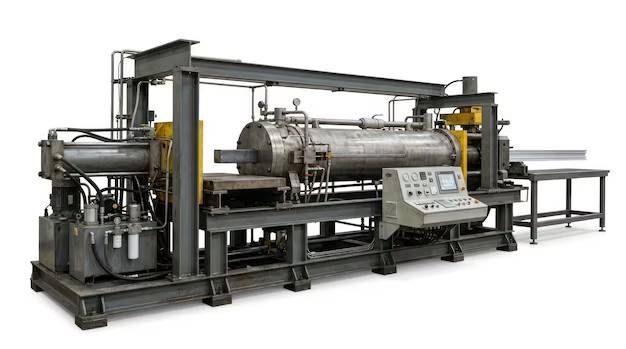
The extruded material is then cooled, calibrated, cut, wound, or subjected to additional processing. Unlike injection molding, which fills a closed mold to produce individual parts, conventional extrusion produces a continuous stream of material. This makes extrusion suitable for products with a consistent cross-sectional shape or continuous length.
How extrusion molding works
An extrusion line typically includes several connected components, each performing a specific function.
Feeding system: Delivers raw material into the machine at a controlled rate.
Hopper: Holds the material before it enters the processing section.
Barrel and screw: Convey, compress, mix, and heat the material.
Heating and cooling zones: Maintain the temperatures needed for stable processing.
Die: Shapes the material as it exits the machine.
Calibration and cooling equipment: Helps the product retain its intended dimensions and shape.
Haul-off system: Pulls the extruded product through the production line at a controlled speed.
Cutting or winding equipment: Produces defined lengths or collects continuous products.
The performance of an extrusion line depends on the relationship between material properties, screw design, temperature, pressure, die geometry, and production speed. Incorrect settings can lead to uneven dimensions, surface defects, unstable flow, or inconsistent product quality.
Materials used in extrusion
Different materials require different machine configurations and processing conditions.
Thermoplastics such as polyethylene, polypropylene, polyvinyl chloride, and polyethylene terephthalate are widely processed through extrusion. These materials soften under suitable heating conditions and can be shaped before cooling or undergoing other required treatment.
Rubber compounds may be extruded to produce seals, hoses, profiles, and other continuous products. Certain metal extrusion processes use substantial pressure to force heated or unheated metal through a die, while food extrusion equipment processes ingredients such as cereals, starches, and protein-based mixtures.
Material selection affects the required temperature range, screw geometry, wear resistance, die design, and downstream equipment. A machine designed for one polymer or process may not be appropriate for another without suitable configuration changes.
Types of Extrusion Molding Machines
Extrusion machines are classified according to screw arrangement, material-processing method, product type, and production requirements. Understanding these differences helps explain how equipment is selected for industrial applications.
Single-screw extruders
Single-screw extruders use one rotating screw inside a heated barrel to transport and process material. They are widely used in plastic pipe production, sheet extrusion, film manufacturing, cable insulation, and profile production.
Their design can be relatively straightforward compared with more complex extrusion systems. Performance depends on the screw's geometry, material characteristics, temperature profile, and required output.
Twin-screw extruders
Twin-screw machines use two screws arranged within a barrel. The screws may rotate in the same direction or in opposite directions, depending on the design and application.
These systems are frequently used for compounding, mixing additives, blending polymers, and processing formulations that require controlled material distribution. Twin-screw extrusion is also used in food processing, chemical production, and certain pharmaceutical manufacturing operations.
Film and sheet extrusion machines
Film extrusion systems manufacture thin plastic films used in packaging, agricultural coverings, protective materials, and industrial applications. Depending on the product, the process may use blown-film extrusion or flat-die casting.
Sheet extrusion equipment produces thicker continuous plastic sheets that may later undergo thermoforming, cutting, lamination, or other operations. Cooling rolls and thickness-control systems help maintain dimensional consistency.
Pipe and profile extrusion machines
Pipe extrusion lines produce continuous tubes and pipes used in water distribution, drainage, construction, and industrial fluid handling. Additional equipment may control diameter, wall thickness, cooling, and dimensional stability.
Profile extrusion machines manufacture products with specific cross-sectional shapes, including window frames, channels, seals, and trim components. The die design is especially important because the material must flow evenly through sections of different thicknesses.
Rubber extrusion machines
Rubber extruders process rubber compounds into continuous forms such as hoses, sealing strips, and technical profiles. Depending on the material, the line may include heating, cooling, vulcanization, or other downstream treatment.
Metal extrusion presses
Metal extrusion presses differ from conventional polymer extruders. They generally use a ram to force a metal billet through a die, producing continuous sections with a defined cross-section. Aluminium is commonly extruded into structural profiles, heat-transfer components, and architectural sections.
Comparison of major machine types
Machine type | Typical materials | Common products |
|---|---|---|
Single-screw extruder | Thermoplastics | Pipes, films, sheets |
Twin-screw extruder | Polymer blends and compounds | Compounded pellets, specialized formulations |
Blown-film line | Flexible thermoplastics | Packaging films, agricultural films |
Pipe extrusion line | PVC, PE, PP and other suitable polymers | Pipes and conduits |
Rubber extruder | Rubber compounds | Hoses, seals, profiles |
Metal extrusion press | Aluminium and other suitable metals | Bars, channels, structural profiles |
These categories can overlap. A complete production line may combine an extruder with specialized dies, calibration systems, cooling equipment, inspection instruments, and automated handling systems.
Importance of Extrusion Molding in Manufacturing
Extrusion molding is important because it enables continuous production of components with consistent shapes and dimensions. Industries use it to manufacture everyday items as well as specialized components for construction, transportation, electrical systems, packaging, and industrial equipment.
The process can accommodate different material formulations and product geometries. Production lines can also incorporate automated feeding, temperature monitoring, dimensional inspection, and cutting systems to maintain repeatable operating conditions.
Industrial applications
Extrusion technology supports a wide range of manufacturing activities.
Construction: Plastic pipes, drainage channels, window profiles, insulation components, and weather seals.
Packaging: Flexible films, protective sheets, multilayer packaging structures, and selected packaging components.
Automotive manufacturing: Rubber seals, plastic trim, protective tubing, and selected lightweight profiles.
Electrical equipment: Cable insulation, protective conduits, and polymer components for electrical installations.
Agriculture: Irrigation pipes, greenhouse films, and agricultural tubing.
Medical manufacturing: Specified tubing, selected polymer profiles, and components manufactured under appropriate quality controls.
Food processing: Extruded cereals, snack products, pasta, and other formulated food products.
Metalworking: Aluminium profiles, structural sections, and heat-transfer components.
Each application has distinct requirements for material properties, dimensional accuracy, surface finish, and regulatory compliance. Medical, food-contact, and electrical applications may require additional controls over material composition and production conditions.
Benefits and operational challenges
Continuous extrusion can support consistent output when material feed, processing temperatures, screw speed, and downstream handling remain within suitable operating ranges. It also allows manufacturers to produce long components without repeatedly loading and unloading a separate mold for every piece.
However, extrusion has technical limitations. Die design can be complex, and changing product dimensions may require different tooling or line adjustments. Material degradation, uneven cooling, screw wear, and unstable melt flow can affect product quality. Manufacturers must also manage energy consumption, equipment maintenance, raw material handling, and waste generated during production.
Factors affecting extrusion quality
Several process variables influence the final product.
Temperature profile: Determines how the material softens, flows, and responds to processing.
Screw speed: Influences material movement, mixing, pressure, and production output.
Die geometry: Controls the shape and distribution of material at the exit.
Cooling conditions: Affect dimensional stability, shrinkage, and surface appearance.
Material moisture: Can cause bubbles or surface defects in moisture-sensitive polymers.
Line speed: Must be coordinated with extrusion output and downstream cooling.
Material formulation: Additives, fillers, and polymer properties influence flow and final performance.
Monitoring these factors helps manufacturers identify process variation and maintain consistent production conditions.
Recent Developments in Extrusion Technology
Developments across 2024–2026 have emphasized process automation, energy monitoring, recycled material processing, and improved control of product dimensions. The pace of adoption varies according to industry requirements, production volumes, and existing equipment.
Automation and intelligent process control
Modern extrusion lines may use programmable logic controllers, temperature sensors, pressure transducers, motor controls, and automated inspection systems. These technologies allow operators to monitor production conditions and adjust selected parameters within defined limits.
Some systems use production data to identify patterns associated with dimensional variation, material changes, or equipment wear. Automated measurement tools can also monitor pipe diameter, sheet thickness, or profile geometry while production continues.
Recycling and material efficiency
Plastic recycling has increased interest in extrusion equipment capable of processing recycled polymers and mixed material streams. Depending on the feedstock, production lines may include washing, drying, filtration, degassing, melt screening, and pelletizing stages.
Recycled materials can vary in composition, contamination level, moisture, and thermal history. These differences may affect mechanical properties and processing stability, so material testing and process control remain important.
Advanced screw and die designs
Screw geometry and die engineering continue to influence mixing, pressure distribution, throughput, and product uniformity. Specialized designs may improve the handling of filled polymers, blends, and materials with particular flow characteristics.
Co-extrusion is another important technique. It combines two or more material streams into a single product, allowing different layers to provide properties such as barrier performance, flexibility, structural support, or surface protection.
Laws, Standards, and Regulatory Considerations
Extrusion machinery and its products may be subject to rules covering machine safety, electrical systems, worker protection, environmental management, and product-specific requirements. Applicable obligations depend on the equipment, material, industry, and country of operation.
Considerations in India
Manufacturers operating extrusion lines in India need to consider applicable occupational safety requirements, electrical safety provisions, environmental rules, and requirements for handling machinery and industrial waste. Plastic processing facilities may also need to assess applicable provisions under India's plastic waste management framework.
Product-specific requirements may apply to pipes, electrical insulation, food-contact packaging, and medical components. Depending on the product and current regulatory notifications, relevant Bureau of Indian Standards requirements or certification obligations may need to be considered.
International technical standards
Several standards and frameworks can be relevant to extrusion operations:
ISO 12100: Principles for machinery safety and risk assessment.
IEC 60204-1: Electrical equipment requirements for machinery.
ISO 9001: Quality management systems.
ISO 14001: Environmental management systems.
Applicable material and product standards: Requirements for dimensions, performance, testing, and product conformity.
These standards have different scopes and are not automatically mandatory in every country or application. Manufacturers should establish which editions, legal requirements, and product specifications apply to their particular equipment and finished products.
Tools and Resources for Extrusion Manufacturing
Extrusion production relies on engineering software, measurement instruments, process monitoring systems, and technical documentation. These resources help manufacturers configure equipment, investigate production defects, and maintain consistent operating conditions.
Common tools and equipment
Extrusion simulation software: Models material flow through screws and dies to examine pressure, temperature distribution, and potential flow imbalance.
Process monitoring systems: Record barrel temperatures, melt pressure, screw speed, motor load, and production output.
Dimensional measurement instruments: Laser gauges, calipers, micrometers, and optical systems measure product thickness, diameter, width, and profile dimensions.
Melt flow testing equipment: Measures the flow behavior of suitable thermoplastic materials under specified temperature and load conditions.
Material testing equipment: Tensile testing machines, impact testers, and other laboratory instruments evaluate selected mechanical properties of extruded products.
Maintenance management software: Helps organize equipment inspections, maintenance schedules, component replacement, and breakdown records.
Selecting an extrusion machine
Machine selection depends on the material being processed, the intended product, and the production environment. Important considerations include:
Material type and processing temperature.
Required output rate and product dimensions.
Screw diameter, screw configuration, and length-to-diameter ratio.
Die design and tooling requirements.
Cooling, calibration, and downstream handling arrangements.
Automation, inspection, and data recording capabilities.
Equipment maintenance needs and applicable safety standards.
A complete production line must be evaluated as a connected system. An extruder's rated output alone does not establish the actual production rate because cooling capacity, tooling, material properties, and downstream equipment can limit overall performance.
Frequently Asked Questions
What is an extrusion molding machine used for?
An extrusion molding machine continuously shapes a material by forcing it through a die. Common products include plastic pipes, films, sheets, rubber profiles, cable insulation, and selected metal components.
What is the difference between single-screw and twin-screw extruders?
A single-screw extruder uses one rotating screw and is widely used for conventional plastic processing. A twin-screw extruder uses two screws and is often selected when a process requires more intensive mixing, compounding, or controlled material handling.
Which materials can be processed through extrusion?
Common materials include polyethylene, polypropylene, PVC, selected engineering plastics, rubber compounds, food mixtures, and metals such as aluminium. Each material requires suitable processing equipment, temperatures, tooling, and operating procedures.
What factors affect extrusion product quality?
Material composition, moisture, temperature, screw speed, die geometry, cooling conditions, and line speed can all influence product quality. Monitoring these variables helps identify defects and maintain dimensional consistency.
How is extrusion molding different from injection molding?
Extrusion generally produces continuous products, such as pipes, sheets, and profiles. Injection molding fills a closed mold to produce individual components with defined three-dimensional shapes.
Conclusion
Extrusion molding machines are widely used to manufacture continuous products from plastics, rubber, metals, and other materials. Different machine configurations, including single-screw, twin-screw, film, pipe, and profile extrusion systems, address distinct production requirements. Automation, material recycling, co-extrusion, and process monitoring continue to shape developments in extrusion technology. Product quality depends on suitable equipment design, material selection, controlled operating conditions, and compliance with relevant technical requirements.