Hardening machines are industrial systems used to improve the hardness, wear resistance, and mechanical performance of metals through controlled heat treatment. They are widely used in automotive manufacturing, aerospace engineering, tool production,
These machines heat metal components under controlled conditions and, depending on the process, rapidly cool them through quenching or use other thermal treatment methods. Different technologies are available for treating entire components or selected surface regions, depending on the required hardness profile, material composition, component geometry, and production requirements.
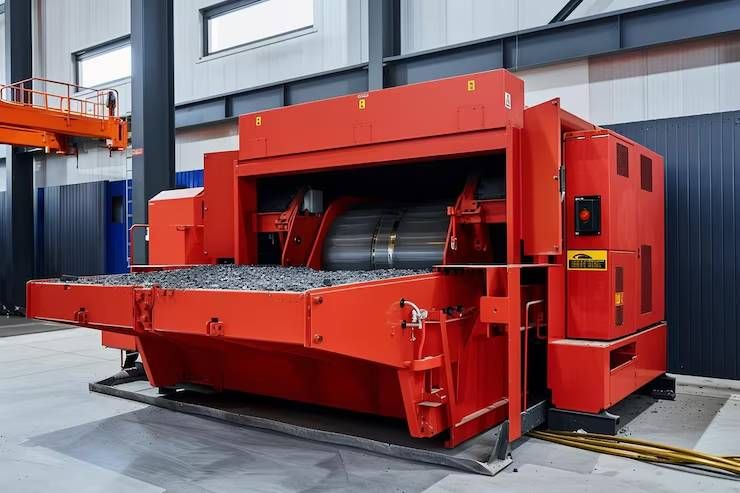
Context
What Is a Hardening Machine?
A hardening machine is equipment designed to perform or support a metal-hardening process. It may use resistance heating, induction heating, controlled-atmosphere heating, laser energy, or other heat sources to bring a component to a specified temperature.
For many steel hardening processes, the component is heated to a temperature at which its microstructure changes, held for a defined period, and then cooled at a controlled rate. This can produce a harder microstructure, depending on the steel composition and treatment conditions.
Some hardening machines treat the entire component, while others concentrate heat on specific surfaces, teeth, shafts, edges, or other selected regions.
Main Types of Hardening Machines
Induction hardening machines use electromagnetic induction to heat electrically conductive components. They are commonly used for gears, shafts, bearing races, crankshafts, and other components requiring localized surface hardening.
Furnace hardening systems heat components inside a furnace under controlled temperature conditions. They can process individual parts, batches, or continuous production loads.
Vacuum hardening furnaces heat components in a low-pressure environment. They are used when reduced oxidation, controlled surface conditions, and precise thermal processing are important.
Atmosphere-controlled hardening furnaces use protective or reactive gases to control surface reactions during heating. Depending on the process, these systems may support hardening, carburizing, carbonitriding, or related treatments.
Laser hardening machines use a focused laser beam to heat selected surface regions. The surrounding material can act as a heat sink, allowing rapid self-quenching in suitable materials and geometries.
Flame hardening machines use a controlled flame to heat a surface before rapid cooling. They are commonly associated with large components or applications where localized surface treatment is required.
Salt-bath systems use heated molten salt as a heat-transfer medium in specific thermal-treatment applications. Their use depends on the process, material, safety requirements, and environmental controls.
Heat Treatment Technologies
Hardening is based on controlled changes in a material's microstructure. In steel, conventional hardening often involves heating into the appropriate austenitizing range followed by sufficiently rapid cooling to form a harder structure.
The required temperature depends on the steel grade, alloy composition, component dimensions, and intended microstructure. Holding time must also allow the required thermal and structural changes without causing undesirable grain growth or distortion.
Quenching can use oil, water, polymer solutions, gas, or other suitable media, depending on the material and treatment process. Cooling severity affects hardness, residual stress, distortion, and the likelihood of cracking.
Tempering is frequently performed after hardening to adjust hardness, toughness, and internal stress. It is a separate heat-treatment stage rather than a substitute for the hardening operation.
| Machine Type | Heating Technology | Typical Applications |
|---|---|---|
| Induction Hardening Machine | Electromagnetic induction | Shafts, gears, bearing races |
| Furnace Hardening System | Electrical or fuel-fired heating | Steel tools and machine components |
| Vacuum Hardening Furnace | Controlled heating under vacuum | Precision components and tools |
| Atmosphere-Controlled Furnace | Heating with controlled gases | Alloy steels and case-hardening processes |
| Laser Hardening Machine | Focused laser energy | Localized surface treatment |
| Flame Hardening Machine | Combustion heating | Large gears and machine parts |
| Salt-Bath System | Heat transfer through molten salts | Specialized thermal treatment |
Importance
Why Hardening Machines Matter
Metal components often operate under friction, repeated loading, impact, or contact stress. Their surfaces may experience wear even when the component core must retain toughness or withstand bending loads.
Hardening machines allow manufacturers to modify material properties to suit these operating conditions. Surface-hardening technologies can create a hard outer region while preserving a comparatively tough core.
The correct treatment depends on the component's function, steel grade, dimensions, service conditions, and required mechanical properties. Hardness alone does not determine overall performance; toughness, fatigue resistance, dimensional stability, and residual stress can also be important.
Surface Hardening and Through Hardening
Through hardening aims to harden a substantial portion of the component cross-section. The result depends on material hardenability, component size, heating conditions, and quenching response.
Surface hardening concentrates the thermal or chemical treatment near the component surface. Induction, flame, and laser hardening can create localized hardened regions without necessarily heating the entire part to the same degree.
Case hardening processes such as carburizing introduce carbon into the surface before subsequent hardening. Carbonitriding introduces both carbon and nitrogen under controlled conditions. These methods differ from purely thermal surface hardening because they alter the surface composition as well as the microstructure.
Main Machine Components
A hardening machine can contain a heating system, workpiece fixture, temperature sensors, process controller, quenching arrangement, cooling system, and safety equipment.
Induction systems additionally require an induction power supply, matching network, and appropriately designed coil. Automated systems may use servo-driven positioning, part rotation, robotic handling, and programmable quench delivery.
Furnace-based systems may include refractory insulation, heating elements or burners, atmosphere controls, circulation fans, and temperature-uniformity monitoring equipment.
Process Control and Quality
Hardening quality depends on the control of temperature, heating rate, holding time, cooling rate, and material condition. In induction and laser systems, the position and movement of the heat source are also important.
Inspection can include hardness measurements, case-depth evaluation, metallographic examination, dimensional inspection, and crack detection. Depending on the component, residual-stress analysis and distortion measurements may also be required.
Manufacturing
Machine Design and Construction
Manufacturing a hardening machine begins with defining the required process, workpiece dimensions, thermal capacity, production volume, and control accuracy.
The machine frame must support the heating equipment, workpiece fixtures, handling mechanisms, and quenching systems. Furnace-based machines require appropriate thermal insulation and temperature-resistant construction.
Induction and laser systems require precise alignment between the energy source and the workpiece. Fixtures must maintain consistent positioning so that the required regions receive the intended thermal treatment.
Heating System Integration
Induction systems use coils designed around the geometry of the component and the desired hardened region. The coil, power supply, frequency, power level, and heating duration influence energy distribution and case depth.
Furnace systems use heating elements or burners arranged to provide the required temperature profile. Vacuum and controlled-atmosphere systems additionally require appropriate sealing, pressure control, and gas-handling components.
Laser hardening systems integrate a laser source, optical delivery system, motion control, and process monitoring.
Quenching and Cooling Systems
Quenching systems remove heat at a controlled rate after the heating stage. They may use liquid sprays, immersion tanks, gas cooling, or specialized cooling arrangements.
For induction hardening, the quench may be delivered through the induction coil or a separate spray assembly. Flow rate, temperature, pressure, and distribution can affect the final result.
Cooling-system design must account for the component geometry and the possibility of distortion, cracking, or uneven hardening.
Automation and Control Systems
Modern hardening machines may include programmable logic controllers, temperature sensors, power monitoring, servo drives, robotic handling, and process-recording software.
Automated systems can repeat heating and quenching sequences with consistent timing and positioning. Sensors and monitoring software can identify deviations from defined process parameters.
Testing and Calibration
Hardening machines may undergo electrical safety checks, temperature verification, power-output checks, quench-flow tests, motion-system verification, and safety-interlock testing.
Process qualification commonly uses representative workpieces to verify hardness, case depth, microstructure, distortion, and other required characteristics.
Industrial Applications
Automotive Manufacturing
Hardening machines are used to treat transmission gears, drive shafts, crankshafts, camshafts, steering components, and other automotive parts.
Induction hardening is particularly relevant where specific surfaces require wear resistance while the core retains toughness.
Bearings and Gears
Bearing races, rollers, gear teeth, and related components may require controlled hardening to withstand contact stress and repeated loading.
The hardening process must be matched to the material and component geometry to achieve the required surface properties without introducing unacceptable distortion.
Tool and Die Manufacturing
Cutting tools, dies, punches, molds, and forming components may undergo hardening to improve resistance to wear and deformation.
Vacuum hardening and controlled-atmosphere processes can be useful for certain tool steels where surface condition and dimensional stability are important.
Heavy Machinery
Large gears, shafts, rollers, pins, and other heavy equipment components may require localized or full-component hardening.
Flame hardening and induction hardening can be applied to large components when the equipment and process are designed for the relevant dimensions.
Aerospace and Precision Engineering
Certain aerospace and precision-engineered components require carefully controlled heat treatment to meet defined mechanical and dimensional specifications.
The appropriate technology depends on the alloy, component design, applicable technical standards, and qualification requirements.
Manufacturers and Suppliers
Hardening machine manufacturers supply equipment for induction hardening, furnace hardening, vacuum heat treatment, laser hardening, flame hardening, and specialized thermal processing.
Suppliers may also provide induction coils, power supplies, quenching units, furnace controls, temperature sensors, automation equipment, fixtures, and process-monitoring systems.
When evaluating equipment, important considerations include the material grades being processed, component size, required hardness and case depth, production volume, heating technology, quenching requirements, temperature uniformity, automation level, and inspection capability.
For precision production, process repeatability, traceability, maintenance requirements, safety systems, and integration with existing manufacturing equipment can also influence selection.
Recent Updates
Advanced Induction Control
Modern induction hardening systems can provide precise control over power, frequency, heating duration, coil movement, and quench timing. These capabilities help manufacturers adapt the process to different component geometries.
Laser Surface Hardening
Laser hardening is used in applications requiring localized treatment and controlled heat input. Computer-controlled beam movement can help produce repeatable hardened patterns on selected surface regions.
Automated Material Handling
Robotic loading, unloading, part positioning, and transfer between heating and quenching stages can improve process consistency and reduce manual handling.
Digital Process Monitoring
Temperature measurements, power data, cycle timing, quench parameters, and other operating information can be recorded for process analysis. These records can support quality investigations and traceability.
Energy and Process Efficiency
Machine development increasingly focuses on efficient heat delivery, reduced idle heating, improved insulation, and process control. The potential benefit depends on equipment design, production pattern, and the selected heat-treatment method.
Laws or Policies
Hardening machines may be subject to requirements covering industrial machinery safety, electrical systems, high-temperature operations, pressure equipment, ventilation, fire protection, and environmental management.
Induction and laser systems require safeguards appropriate to their electrical power, electromagnetic fields, optical radiation, and operating environment. Furnace systems may introduce burn, combustion, atmosphere-control, and hot-surface hazards.
Quenching fluids can create fire, chemical exposure, spill, and thermal hazards depending on their composition and operating conditions. Appropriate handling, ventilation, guarding, and emergency procedures are important.
Manufacturers and operators should follow equipment documentation, workplace safety procedures, applicable machinery standards, and relevant environmental regulations. Specific requirements vary by jurisdiction and process.
Tools and Resources
Hardening operations commonly use Rockwell, Vickers, or Brinell hardness testers, depending on the material and testing requirements. Metallographic microscopes and sample-preparation equipment can support examination of microstructure and hardened depth.
Other resources include thermocouples, temperature data loggers, infrared measurement systems, quench-flow instruments, dimensional gauges, magnetic-particle inspection equipment, and ultrasonic testing systems where appropriate.
Useful documentation includes heat-treatment specifications, material certificates, machine manuals, process qualification records, calibration certificates, maintenance procedures, and safety documentation.
FAQs
What is a hardening machine?
A hardening machine is industrial equipment used to heat and cool metal components under controlled conditions to change their hardness and related mechanical properties.
What are the main types of hardening machines?
Common types include induction hardening machines, furnace hardening systems, vacuum furnaces, controlled-atmosphere furnaces, laser hardening machines, flame hardening systems, and specialized salt-bath equipment.
What is the difference between induction hardening and furnace hardening?
Induction hardening uses electromagnetic energy to heat selected regions rapidly, often for surface hardening. Furnace hardening heats components inside a chamber and is commonly used when broader or through-section treatment is required.
What is the purpose of quenching?
Quenching removes heat rapidly or at a controlled rate after heating. In suitable steels, it can produce a harder microstructure, but the result depends on material composition, component geometry, and cooling conditions.
Which industries use hardening machines?
Automotive manufacturing, bearing production, gear manufacturing, toolmaking, heavy machinery, aerospace engineering, and general metalworking are common application areas.
Conclusion
Hardening machines are important industrial systems for changing the surface or bulk properties of metals through controlled heat treatment. Induction, furnace, vacuum, laser, flame, and other hardening technologies provide different approaches to heating and cooling components.
The selection of a hardening system depends on material composition, component geometry, required hardness, hardened depth, production volume, distortion limits, and process-control needs. Heating, quenching, tempering, inspection, and quality documentation must be considered together to achieve the intended material characteristics.
Advances in induction control, laser processing, automation, and digital monitoring continue to improve the precision and repeatability of industrial hardening operations.