Industrial metal sorting equipment is used to identify, separate, and recover different metals from mixed materials, scrap streams, manufacturing residues, and industrial waste. These systems help recycling facilities, metal processors, mining operations, and manufacturers improve material recovery and prepare metals for reuse.
Modern metal sorting systems use magnetic separation, eddy current technology, sensor-based identification, X-ray fluorescence, laser sensing, and automated material handling. The appropriate technology depends on the metal types, material size, feed composition, throughput, and required sorting accuracy.+
Context
What Is Industrial Metal Sorting Equipment?
Industrial metal sorting equipment consists of machines and integrated systems that identify and separate metals according to their magnetic, electrical, chemical, optical, or density-related properties.
Unlike simple metal detection equipment, which primarily identifies the presence of metal, sorting equipment physically separates selected materials into different output streams. Depending on the design, it may recover ferrous metals, separate non-ferrous metals, distinguish different alloy grades, or remove unwanted contaminants from mixed feed.
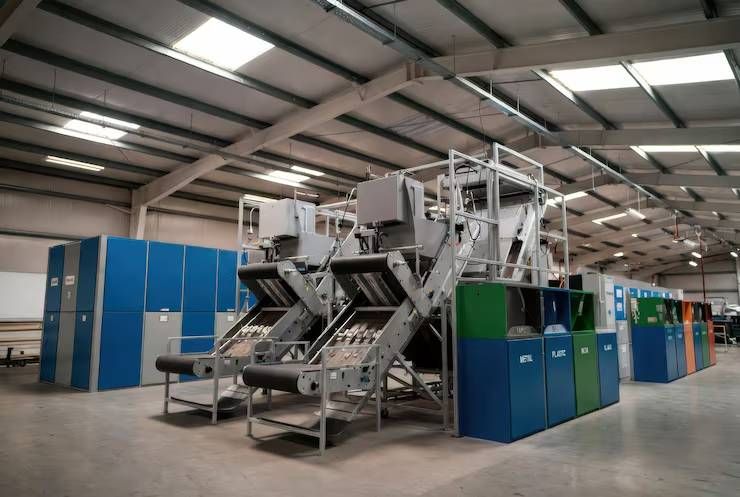
A typical sorting installation may include a conveyor belt, feed hopper, screening equipment, detection sensors, processing units, air jets, mechanical diverters, magnetic assemblies, and collection bins. Advanced systems can combine multiple technologies to improve material identification and recovery.
Industrial metal sorting equipment is used in scrap yards, automobile recycling plants, electronic waste processing facilities, foundries, steelworks, mining operations, and municipal waste treatment plants.
Major Types of Industrial Metal Sorting Equipment
1. Magnetic Separators
Magnetic separators use magnetic fields to remove ferrous metals, including iron and many steel components, from mixed materials.
Common configurations include overband magnets, suspended magnets, magnetic drums, and magnetic pulleys. These systems are widely used in recycling, mining, aggregate processing, and industrial waste handling.
Magnetic separation is generally the first stage in many metal recovery lines because it can remove substantial quantities of ferrous material before more specialized sorting processes.
2. Eddy Current Separators
Eddy current separators are designed to recover conductive non-ferrous metals, including aluminum and selected copper-bearing materials, from mixed waste streams.
A rapidly rotating magnetic rotor creates a changing magnetic field that induces electrical currents in conductive particles. The resulting forces help eject these particles from the main material stream.
Eddy current systems are commonly used in municipal waste processing, aluminum recycling, electronic waste treatment, and automobile shredding facilities.
3. Sensor-Based Metal Sorting Systems
Sensor-based sorting systems identify materials using one or more sensors and then direct them into separate output streams. The sensors may detect differences in electrical conductivity, magnetic response, chemical composition, or other measurable characteristics.
After identification, the machine may use compressed-air jets, mechanical gates, or other actuators to separate individual pieces.
These systems can be used to sort metal scrap, industrial residues, and selected mineral-processing materials.
4. X-Ray Fluorescence Sorting Machines
X-ray fluorescence (XRF) sorting systems identify elemental composition by measuring characteristic X-rays emitted from a material when it is exposed to an X-ray source.
They can help distinguish certain alloy grades, including stainless steel and selected copper-, nickel-, or aluminum-based alloys, when the system is configured for the relevant materials.
XRF sorting is particularly useful when visual appearance alone cannot reliably distinguish different metal compositions.
5. Laser-Induced Breakdown Spectroscopy Sorting Systems
Laser-induced breakdown spectroscopy (LIBS) uses a laser pulse to create a small plasma on a material surface. The emitted light is analyzed to determine elemental composition.
Industrial LIBS systems can identify and separate certain alloy grades and metal compositions. Their performance depends on surface conditions, material geometry, measurement speed, and the alloys being distinguished.
6. Induction-Based Sorting Equipment
Induction-based sorting systems use electromagnetic sensing to identify differences in electrical conductivity or related material properties. Depending on the equipment design, they may distinguish selected non-ferrous metals from other materials.
These systems are used in recycling and scrap-processing applications where rapid material identification is required.
7. Optical and Vision-Based Sorting Systems
Optical sorting systems use cameras and image-processing software to classify objects according to visible characteristics such as shape, size, color, or surface appearance.
Vision systems can support metal sorting when combined with other sensors. However, visual information alone may not reliably identify an alloy because different metals can look similar.
8. Combined Sorting Lines
Combined sorting lines integrate multiple machines to recover different material categories in sequence. A line may begin with screening and magnetic separation, continue with eddy current separation, and then use sensor-based equipment to identify specific alloys.
This configuration can improve overall material recovery by assigning different sorting tasks to technologies suited to each material category.
Industrial Metal Sorting Technologies
Different sorting technologies rely on different physical properties.
Magnetic separation: Uses magnetic attraction to recover ferrous materials.
Eddy current separation: Uses electromagnetic induction to eject conductive non-ferrous metals.
X-ray fluorescence: Identifies elemental composition through characteristic X-ray emissions.
Laser-induced breakdown spectroscopy: Analyzes emitted light to estimate elemental composition.
Inductive sensing: Detects metal-related changes in electromagnetic properties.
Optical recognition: Uses cameras and software to classify visible material features.
Automated mechanical sorting: Uses gates, diverters, robotic handling, or air jets to direct identified pieces into separate streams.
The appropriate technology depends on the material mix, particle dimensions, contamination level, production speed, and required separation accuracy.
Comparison of Industrial Metal Sorting Equipment
| Equipment type | Main technology | Typical applications |
|---|---|---|
| Magnetic separator | Magnetic attraction | Iron and steel recovery |
| Eddy current separator | Electromagnetic induction | Aluminum and other conductive non-ferrous metals |
| Sensor-based sorter | Material identification sensors | Mixed scrap and industrial residues |
| XRF sorter | Elemental analysis | Alloy identification |
| LIBS sorter | Laser-based elemental analysis | Advanced alloy sorting |
| Induction sorter | Electromagnetic sensing | Selected non-ferrous metal streams |
| Optical sorting system | Cameras and image analysis | Visual classification and automated sorting |
| Combined sorting line | Multiple technologies | Complex recycling and scrap processing |
Importance of Industrial Metal Sorting Equipment
Industrial metal sorting equipment helps recover valuable raw materials, reduce waste, and improve the quality of recycled metals. By separating different metal categories, processors can prepare more consistent material streams for remelting, refining, and manufacturing.
Accurate sorting is particularly important when different alloy compositions must remain separate. Mixing incompatible metal grades can affect the properties of the final product and create difficulties during downstream processing.
Metal sorting also supports resource efficiency. Recovering aluminum, copper, steel, and other metals from discarded products can reduce the demand for newly extracted raw materials, although the environmental benefits depend on the material, energy use, and complete recycling process.
Automated sorting can reduce manual handling and improve throughput in high-volume facilities. It can also help remove unwanted material before it reaches shredders, furnaces, or other processing equipment.
Performance should be assessed using measures such as recovery rate, product purity, throughput, misclassification rate, and operating stability. A machine that achieves high throughput may still require additional stages if its output purity does not meet the intended application.
Manufacturing Processes
Industrial metal sorting equipment manufacturing combines mechanical engineering, sensor integration, electrical systems, software development, and automated material handling.
1. Design and Engineering
The manufacturing process begins with defining the material stream, target metal categories, feed dimensions, required throughput, and desired output purity.
Engineers determine the conveyor width, sensor arrangement, sorting mechanism, frame dimensions, drive system, and control architecture. Computer-aided design helps establish mechanical layouts, clearances, mounting positions, and maintenance access.
For sensor-based systems, the design also considers detection distance, material presentation, measurement speed, and the required response time for the sorting mechanism.
2. Material Selection
Equipment frames and structural components are commonly manufactured from carbon steel, stainless steel, or other suitable alloys. Material selection depends on mechanical loading, corrosion exposure, abrasion, and the operating environment.
Wear-resistant liners may be installed in chutes and feed areas exposed to abrasive scrap. Stainless steel may be selected for components that require corrosion resistance or easier cleaning.
Sensor housings, electrical enclosures, and protective covers are chosen according to environmental and operational requirements.
3. Mechanical Fabrication
Frames, conveyor structures, hoppers, chutes, brackets, and protective guards are manufactured using cutting, bending, machining, welding, and forming operations.
Conveyor systems require correctly aligned rollers, belts, pulleys, bearings, and drive assemblies. Feeding components must distribute material evenly to help prevent overlapping objects from interfering with sensor readings.
Precision machining may be required for shafts, rotor assemblies, bearings, and other components with specific dimensional tolerances.
4. Magnetic and Sensor Assembly
Magnetic separators require correctly positioned permanent magnets or electromagnetic assemblies. Eddy current separators require a rotor, magnetic components, drive system, and protective enclosure designed for high-speed operation.
Sensor-based machines may incorporate XRF detectors, LIBS systems, inductive sensors, optical cameras, or combinations of these technologies.
Sensor placement, shielding, calibration, and environmental protection are important because vibration, dust, moisture, and electromagnetic interference can affect performance.
5. Electrical and Control-System Integration
Electrical components include motors, drives, control panels, sensors, safety switches, and communication interfaces. Programmable logic controllers and industrial computers coordinate conveyor operation, sensor readings, and sorting actions.
Software processes sensor data and assigns material categories according to defined classification rules. The control system then activates the relevant diverter, air jet, or mechanical handling device.
Systems may include operator interfaces, fault monitoring, throughput measurement, and production data recording.
6. Assembly and Calibration
After mechanical and electrical assembly, the equipment is checked for alignment, correct operation, and safe access to moving components.
Sensor-based sorting machines may require calibration using representative materials with known properties. Sorting algorithms and operating thresholds are configured according to the target metal categories.
Eddy current separators may require adjustment of rotor speed, conveyor speed, and material presentation. Magnetic systems are checked for appropriate field arrangement and physical clearances.
7. Performance Testing and Quality Control
Testing verifies whether the completed machine meets its intended operating requirements.
Common checks include:
Conveyor alignment and speed verification
Magnetic-field or sensor-function checks
Rotor and drive-system inspection
Electrical and safety-control testing
Calibration using representative material samples
Sorting accuracy and material recovery trials
Output purity and throughput measurements
Verification of air jets or mechanical diverters
Inspection of guarding, emergency stops, and maintenance access
Performance testing should use material that reflects the expected feed stream. Laboratory calibration alone does not establish sorting accuracy under full industrial conditions.
Global Manufacturers and Suppliers
The industrial metal sorting sector includes manufacturers of magnetic separation systems, recycling machinery, sensor-based sorters, alloy identification equipment, and integrated processing lines.
STEINERT: Develops magnetic separation and sensor-based sorting technologies used in metal recycling, scrap processing, and resource recovery.
TOMRA Recycling: Provides sensor-based sorting systems for recycling applications, including selected metal and scrap streams.
Eriez: Manufactures magnetic separation, eddy current, and other material separation equipment for recycling and industrial processing.
Bunting: Produces magnetic separation and metal recovery equipment for scrap processing, plastics, mining, and other material-handling applications.
Sesotec: Develops sorting and detection systems for selected industrial materials, plastics, recycling, and contamination-control applications.
REDWAVE: Supplies sensor-based sorting systems for waste processing, metal recovery, and industrial recycling applications.
Binder+Co: Manufactures screening, sorting, and processing technologies for industrial materials and recycling applications.
RTT System: Associated with sensor-based sorting and material recovery technologies; specific current metal sorting configurations should be confirmed directly.
These companies specialize in different equipment categories. Not every manufacturer supplies magnetic separators, eddy current systems, XRF sorters, LIBS sorters, and complete recycling lines.
When evaluating manufacturers and suppliers, consider target metal categories, feed size, sorting accuracy, throughput, output purity, calibration procedures, maintenance access, energy requirements, technical documentation, and regional support availability.
Representative material testing is useful when determining whether a particular sorting technology can distinguish the target metals under actual operating conditions.
Industrial Applications
1. Scrap Metal Recycling
Scrap-processing facilities use magnetic separators, eddy current separators, and sensor-based sorters to recover metals from mixed scrap. Different stages can separate ferrous metals, non-ferrous metals, and selected alloy grades.
Sorting helps prepare material streams for further processing and remelting.
2. Automobile Recycling
End-of-life vehicles contain steel, aluminum, copper, and numerous alloy components. After dismantling and shredding, sorting equipment helps recover ferrous and non-ferrous materials from mixed fragments.
Advanced sensor-based systems can further separate selected alloys to improve material quality for recycling.
3. Electronic Waste Processing
Electronic waste contains copper, aluminum, steel, and other metals within complex assemblies. Metal sorting equipment helps recover these materials after suitable dismantling, shredding, and preprocessing.
The process must account for plastics, glass, circuit-board fragments, and other materials that may interfere with separation.
4. Aluminum Recycling
Aluminum scrap can contain different alloys with varying chemical compositions. Sensor-based alloy sorting helps separate selected grades before remelting.
The correct sorting method depends on the alloy families involved, surface condition, object geometry, and required composition control.
5. Copper and Non-Ferrous Metal Recovery
Eddy current and sensor-based systems help recover conductive non-ferrous metals from mixed waste and industrial residues. Further sorting may be required to separate copper, aluminum, brass, and other material categories.
6. Steelworks and Foundries
Steelworks and foundries use magnetic separation and other sorting technologies to prepare scrap feed and remove unwanted material. Consistent scrap composition can support process control and reduce unwanted elements in the resulting metal.
7. Mining and Mineral Processing
Mining facilities may use metal sorting technologies to recover metal-bearing material, remove unwanted objects, or sort selected mineral streams. Applications depend on the ore properties, particle dimensions, and whether the target is metallic scrap or mineral-bearing rock.
8. Construction and Demolition Waste
Construction waste contains reinforcing steel, structural metals, aluminum, and mixed materials. Magnetic and eddy current separators can recover metal fractions from processed waste, while sensor-based sorting may further distinguish selected materials.
9. Industrial Manufacturing Residues
Manufacturing operations generate metal offcuts, machining chips, rejected components, and mixed production residues. Sorting equipment can separate material categories for recycling and help prevent incompatible metals from entering the same recovery stream.
Recent Developments
Industrial metal sorting continues to advance through improvements in sensor resolution, automated material handling, digital control, and classification software.
Advanced XRF and LIBS systems can distinguish selected alloy categories based on elemental composition. Improvements in sensor processing and material presentation can support faster classification and more consistent sorting under suitable operating conditions.
Artificial intelligence and machine-learning methods are being applied to image analysis and selected sensor-based sorting tasks. These methods may help classify complex material streams, but their performance depends on training data, sensor quality, material variation, and operating conditions.
Robotic systems are also being integrated into certain sorting operations. Robots equipped with cameras and other sensors can identify and pick selected objects, particularly where material geometry allows reliable handling.
Digital monitoring systems can track throughput, equipment status, fault events, and sorting performance. These data can help operators identify process changes and plan maintenance.
The most effective installations often combine technologies rather than depend on a single machine. Screening, magnetic separation, eddy current separation, and alloy sorting can each address a different stage of the material recovery process.
Laws or Policies
Industrial metal sorting equipment may be subject to machinery safety, electrical safety, environmental, and workplace requirements. Specific obligations depend on the installation, equipment design, and country of operation.
Machines with conveyors, high-speed rotors, robotic mechanisms, or pneumatic sorting devices require appropriate guarding, emergency-stop arrangements, and safe maintenance procedures.
XRF and other X-ray-based systems require suitable radiation protection measures, safety interlocks, and compliance with applicable radiation regulations. Laser-based systems may require laser safety controls according to their classification and installation.
Recycling facilities may also need to comply with requirements for waste handling, dust control, noise, emissions, and storage of hazardous materials.
In the European Union, applicable machinery and electrical safety legislation depends on the equipment and its intended use. In the United States, workplace safety, electrical installation, environmental, and radiation-related requirements may apply.
Relevant ISO and IEC standards may address quality management, electrical safety, and selected equipment characteristics. Operators should verify which requirements apply to the complete installation rather than assuming one standard covers every sorting technology.
Tools and Resources
Several tools help engineers select, evaluate, and maintain industrial metal sorting equipment.
Material composition analyzers: Identify elemental composition and support alloy classification.
Magnetic-field meters: Measure magnetic flux density at specified positions.
Particle-size analysis tools: Establish the size distribution of incoming material.
Conveyor speed measurement instruments: Verify feed and separation conditions.
Sensor calibration materials: Help verify classification performance for known metal types.
Throughput and recovery measurements: Evaluate processing capacity and material recovery.
Maintenance records: Track rotor wear, sensor faults, conveyor problems, and performance changes.
Manufacturer technical documentation: Provides operating limits, installation requirements, calibration guidance, and maintenance instructions.
Before selecting equipment, define the incoming material composition, target metal categories, particle size, required throughput, acceptable contamination, and desired output purity. Testing representative samples can reveal whether a single sorting stage is sufficient or whether several technologies are needed.
FAQs
1. What is industrial metal sorting equipment used for?
It is used to separate metals from mixed materials, recover valuable scrap, distinguish selected alloy grades, and improve the purity of material streams for recycling and manufacturing.
2. What is the difference between magnetic separation and eddy current separation?
Magnetic separation primarily recovers ferrous materials through magnetic attraction. Eddy current separation uses electromagnetic induction to separate conductive non-ferrous metals such as aluminum and selected copper-bearing materials.
3. Can industrial sorting machines distinguish different metal alloys?
Yes. Certain sensor-based systems use XRF, LIBS, or other material identification technologies to distinguish selected alloys. Performance depends on the alloy categories, material presentation, sensor configuration, and operating conditions.
4. Which industries use metal sorting equipment?
Scrap recycling, automobile recycling, electronic waste processing, aluminum recovery, steelworks, foundries, mining, construction waste processing, and industrial manufacturing all use metal sorting technologies.
5. How is metal sorting performance measured?
Performance can be evaluated using material recovery, output purity, throughput, misclassification rate, and equipment availability. Testing with representative feed material is important because actual results depend on the composition and condition of the incoming stream.
Conclusion
Industrial metal sorting equipment supports material recovery, recycling, alloy separation, and quality control across numerous industrial sectors. Magnetic separators, eddy current systems, sensor-based sorters, XRF equipment, LIBS systems, and integrated sorting lines address different material characteristics and processing requirements.
Selecting a suitable system requires understanding the incoming feed, target metal categories, throughput, output purity, and operating environment. Careful equipment evaluation, representative testing, appropriate safety measures, and routine performance monitoring can help industrial facilities achieve consistent metal recovery.