Industrial respirators are protective devices designed to reduce workers' exposure to airborne hazards such as dust, fumes, aerosols, mists, and certain gases or vapors. They are used in manufacturing plants, construction, mining, chemical processing, metalworking, pharmaceuticals, and other industrial environments where respiratory protection may be necessary.
Respirators work through filtration, air purification, or the delivery of breathable air from an independent source. Their selection depends on the contaminant, its concentration, oxygen availability, work conditions, and the protection requirements established by an appropriate respiratory protection program.
Context
What Are Industrial Respirators?
An industrial respirator is personal protective equipment designed to protect the respiratory system against specified airborne hazards. Depending on the design, it may filter particles from inhaled air, remove selected gases and vapors through specialized sorbent materials, or supply clean breathing air.
Respirators differ from ordinary face coverings because approved industrial models are tested against defined performance requirements. However, the protection provided by any respirator depends on selecting the correct type, ensuring a proper fit where required, maintaining the equipment, and following the manufacturer's instructions.
Some respirators cover the nose and mouth, while others use full-face masks, hoods, helmets, or powered breathing systems.
Main Types of Industrial Respirators
Filtering facepiece respirators use a filter material integrated into the facepiece. They are commonly used for certain airborne particles, including dust and some aerosols, when the specific model is appropriate for the hazard.
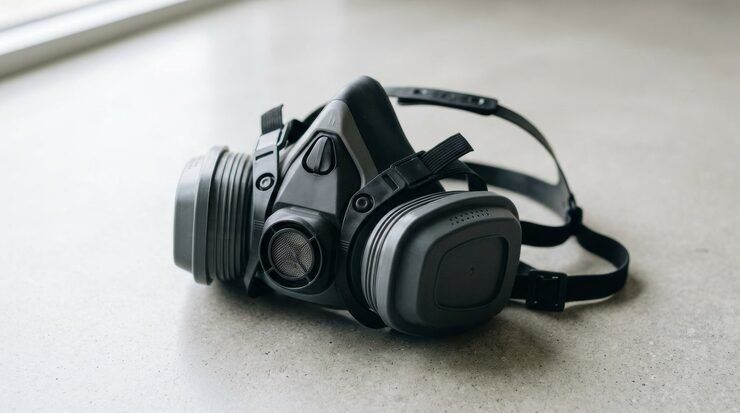
Elastomeric half-mask respirators use a reusable facepiece fitted with replaceable filters or cartridges. They can protect against specified particles, gases, and vapors when equipped with compatible components.
Full-face respirators cover the eyes, nose, and mouth. Depending on their configuration, they can provide respiratory protection and eye protection against specified hazards.
Powered air-purifying respirators (PAPRs) use a battery-powered blower to draw air through suitable filters or cartridges and deliver it to a facepiece, hood, or helmet.
Supplied-air respirators deliver breathing air from a remote source through a hose. They are used in applications where air-purifying equipment is unsuitable or where the respiratory protection program specifies supplied air.
Self-contained breathing apparatus (SCBA) carries a breathing-air supply on the user's back. It is used in certain emergency response, firefighting, and hazardous-entry operations.
Respirator Filtration Technologies
Respirator filtration technology varies according to the type of airborne contaminant.
Particle filters use fibrous media to capture airborne particles through mechanisms such as interception, impaction, diffusion, and electrostatic attraction. Filter design, fiber structure, airflow resistance, and particle characteristics influence filtration performance.
Gas and vapor cartridges use sorbent materials, often activated carbon or specialized chemical media, to capture or react with selected contaminants. Different cartridge formulations target different chemicals, so a cartridge suitable for one gas or vapor may not protect against another.
Combination filters integrate particle filtration with gas or vapor removal. These systems may be used when multiple types of contaminants are present, provided the complete configuration is appropriate for the exposure.
Respirator Components
Industrial respirators can contain several interconnected components. The facepiece creates the interface between the equipment and the wearer. Straps, seals, valves, and connectors help maintain the intended configuration.
Filters capture particles, while cartridges or canisters contain materials designed to remove specified gases and vapors. Powered systems additionally include a blower, battery, airflow controls, and charging components.
Supplied-air systems include breathing-air hoses, regulators, connectors, and air-supply equipment. SCBA systems also contain a portable air cylinder and associated pressure-control components.
| Respirator Type | Main Protection Method | Typical Application |
|---|---|---|
| Filtering Facepiece | Integrated particle filtration | Dust and specified aerosols |
| Half-Mask Respirator | Replaceable filters or cartridges | Manufacturing and maintenance |
| Full-Face Respirator | Filtration or cartridge-based protection | Specified chemical and particle hazards |
| PAPR | Powered filtration and airflow | Selected industrial tasks |
| Supplied-Air Respirator | Remote breathing-air supply | Specialized hazardous work |
| SCBA | Portable breathing-air supply | Emergency response and hazardous entry |
Importance
Why Industrial Respirators Matter
Airborne contaminants can enter the respiratory system and affect worker health. The nature and severity of the risk depend on the substance, concentration, exposure duration, particle characteristics, and individual circumstances.
Respirators form one part of a broader occupational exposure-control strategy. Where feasible, engineering controls such as enclosure, local exhaust ventilation, process isolation, and substitution should be considered before relying on personal protective equipment alone.
A respiratory protection program helps ensure that equipment selection, fit testing, training, maintenance, and replacement are managed systematically.
Particle Filtration
Particle filtration is relevant to work involving grinding, cutting, sanding, welding, powder handling, and other activities that generate airborne particles.
Different filter classes have different test requirements and performance characteristics. For example, N95 is a US particulate-filter classification, while P100 denotes a higher particulate-filtration class under the relevant US standard. These labels should not be assumed to apply identically across all national certification systems.
The appropriate filter depends on the contaminant and the applicable exposure assessment. Particle filters do not automatically protect against gases, vapors, or oxygen deficiency.
Gas and Vapor Protection
Gas and vapor cartridges are designed for specified chemical hazards. Their effectiveness depends on the cartridge chemistry, contaminant identity, concentration, humidity, temperature, breathing rate, and other conditions.
Cartridges have finite service lives. A suitable replacement schedule should be established through the respiratory protection program and manufacturer guidance rather than relying solely on odor as a warning.
Air-purifying respirators are not appropriate for oxygen-deficient atmospheres or environments that are immediately dangerous to life or health. Such situations require specialized equipment and procedures established by qualified personnel.
Fit and Seal
A respirator's performance depends on how well it fits the wearer. Tight-fitting facepieces require appropriate fit testing, and users should perform the seal checks specified by the manufacturer and applicable program.
Facial hair that crosses the sealing surface can interfere with the seal of tight-fitting respirators. Loose-fitting hoods and helmets used with certain powered or supplied-air systems follow different requirements.
Selection should also consider compatibility with eye protection, hearing protection, helmets, and other equipment used in the workplace.
Manufacturing Processes
Material Selection
Respirator manufacturing begins with selecting materials suitable for the intended application. Facepieces may use elastomers, thermoplastics, silicone, or other engineered materials.
Filter media may consist of nonwoven fibers, electrostatically charged materials, or specialized sorbents. Valves, straps, seals, and connectors are selected according to durability, airflow, compatibility, and performance requirements.
Filter Media Production
Particle-filter media can be manufactured through processes such as melt blowing, fiber formation, web bonding, and electrostatic charging. The resulting material is evaluated for filtration efficiency, airflow resistance, and structural consistency.
Gas and vapor cartridges require appropriate sorbent selection, filling, sealing, and assembly. The cartridge design must maintain contact between the incoming air and the intended filtration medium.
Facepiece Molding and Assembly
Reusable facepieces are often produced through molding processes. Components are assembled with valves, straps, filter connections, and sealing elements.
Manufacturing controls help ensure consistent dimensions, connection integrity, and compatibility between components.
Testing and Quality Assurance
Respirators are evaluated through tests relevant to their design and intended certification. These may include filtration performance, breathing resistance, leakage, valve performance, mechanical durability, and component integrity.
Manufacturers also use quality-management procedures to control raw materials, production processes, inspection records, and product traceability.
Certification requirements vary according to the jurisdiction and respirator category. Products intended for regulated industrial use should be checked against the applicable approval system.
Global Manufacturers and Suppliers
The industrial respiratory protection market includes manufacturers producing disposable respirators, reusable facepieces, filters, chemical cartridges, powered systems, and supplied-air equipment.
Examples of established manufacturers include 3M, Dräger, MSA Safety, Honeywell, Moldex, and GVS. Their product portfolios vary by market and may include several respiratory protection categories.
Suppliers and industrial distributors may provide respirators, compatible replacement filters, cartridges, fit-testing materials, storage accessories, and maintenance components.
When evaluating a manufacturer or supplier, important considerations include the required protection class, applicable certification, compatibility between facepieces and filters, product availability, replacement-component continuity, technical documentation, and training resources.
Product selection should be based on the actual workplace hazard assessment rather than brand recognition alone.
Industrial Applications
Manufacturing and Metalworking
Manufacturing environments may involve airborne dust, metalworking aerosols, welding fumes, and other contaminants. Respirators may be used alongside extraction systems and process controls where exposure assessments indicate a need.
Construction and Mining
Construction and mining can involve silica-containing dust, mineral particles, diesel exhaust, and other airborne hazards. The required respiratory protection depends on the material, task, concentration, and applicable workplace standards.
Chemical Processing
Chemical plants may handle gases, vapors, mists, and particles with different toxicological properties. Cartridge selection and respirator type must match the specific chemical and operating conditions.
Unknown concentrations, oxygen deficiency, or immediately dangerous atmospheres require specialized procedures and equipment rather than routine air-purifying respirators.
Pharmaceutical and Laboratory Operations
Pharmaceutical manufacturing and laboratory work can involve powders, aerosols, chemical vapors, and other exposure risks. Respiratory protection requirements depend on the materials, process containment, exposure assessment, and laboratory procedures.
Emergency Response
Emergency responders may use full-face SCBA systems in environments where the atmosphere is unknown, oxygen-deficient, or immediately dangerous to life or health. Such systems require specialized training, inspection, and operational procedures.
Recent Updates
Improved Filter Media
Filter development focuses on capturing specified airborne particles while managing breathing resistance. Fiber structure, electrostatic properties, and media arrangement can influence filtration performance.
Any performance claim should be supported by the relevant standardized testing and certification.
Powered Respiratory Protection
Powered air-purifying systems can supply filtered air to compatible hoods, helmets, or facepieces. These systems may be useful for selected tasks where equipment weight, airflow, duration, and compatibility have been evaluated.
Battery condition, airflow checks, filter selection, and maintenance remain important operational considerations.
Connected Safety Equipment
Some modern respiratory systems can integrate electronic airflow indicators, battery monitoring, alarms, or communication equipment. These features can help users monitor equipment status but do not replace correct selection, training, or exposure controls.
Improved Ergonomics
Manufacturers continue to refine facepiece design, weight distribution, visibility, adjustment mechanisms, and compatibility with other protective equipment.
Comfort can support correct use, but it does not establish that a respirator provides adequate protection for a particular hazard.
Sustainability and Reusable Systems
Reusable respirators can reduce the number of disposable facepieces required in suitable applications. Their use depends on appropriate cleaning, inspection, storage, filter replacement, and contamination-control procedures.
Disposable and reusable options should be compared according to the workplace risk assessment, hygiene requirements, product lifecycle, and applicable policies.
Laws or Policies
Industrial respirators are regulated through occupational safety and product certification requirements that vary by country.
In the United States, the National Institute for Occupational Safety and Health (NIOSH) approves respirators under applicable federal requirements. Occupational Safety and Health Administration (OSHA) rules establish employer obligations for respiratory protection in covered workplaces, including program administration, medical evaluation, fit testing for tight-fitting respirators, training, and maintenance where applicable.
In the European Union, respiratory protective equipment is subject to the applicable personal protective equipment framework and relevant conformity-assessment requirements. Standards and marking requirements depend on the equipment category.
Other countries maintain their own certification and workplace safety frameworks. Employers should verify that the selected equipment is approved for the intended use in the relevant jurisdiction.
Respirator selection should be integrated with a documented hazard assessment and respiratory protection program. Applicable requirements may cover exposure monitoring, medical suitability, fit testing, user training, cleaning, inspection, storage, cartridge replacement, and recordkeeping.
Tools and Resources
Respiratory protection programs may use fit-testing equipment, particle counters, air-sampling instruments, gas detectors, airflow measurement devices, and inspection tools.
Other resources include manufacturer instructions, filter and cartridge selection guides, chemical safety data sheets, certification databases, exposure assessment reports, cleaning procedures, and replacement schedules.
Fit-testing and exposure-assessment equipment should be used by appropriately trained personnel following the applicable procedures and standards.
FAQs
What is an industrial respirator?
An industrial respirator is protective equipment designed to reduce exposure to specified airborne contaminants. It can filter particles, remove selected gases and vapors, or supply breathable air from an independent source.
What are the main types of industrial respirators?
Common categories include filtering facepieces, reusable half-mask respirators, full-face respirators, powered air-purifying respirators, supplied-air respirators, and self-contained breathing apparatus.
What is the difference between a particle filter and a gas cartridge?
A particle filter captures specified airborne particles, while a gas or vapor cartridge uses specialized materials to remove selected chemical contaminants. One type should not be assumed to protect against hazards addressed by the other.
How often should respirator filters or cartridges be replaced?
Replacement depends on the filter or cartridge type, contaminant, exposure conditions, manufacturer instructions, and workplace respiratory protection program. Gas and vapor cartridges require a suitable change schedule rather than reliance on odor alone.
Can an air-purifying respirator be used in an oxygen-deficient environment?
No. Air-purifying respirators do not supply oxygen and are not suitable for oxygen-deficient atmospheres. Such environments require specialized assessment, equipment, and procedures.
Conclusion
Industrial respirators are important components of occupational respiratory protection in manufacturing, construction, mining, chemical processing, pharmaceuticals, and emergency response. Different designs use particle filtration, gas and vapor sorbents, powered airflow, or independent breathing-air supplies.
Effective respiratory protection depends on identifying the hazard, selecting the appropriate approved equipment, ensuring compatibility and fit, maintaining the device, and providing proper training. Respirators should form part of a broader exposure-control strategy that prioritizes suitable engineering and administrative controls wherever feasible.
Advances in filtration media, powered systems, ergonomics, monitoring, and reusable equipment continue to influence respiratory protection technology. Appropriate certification, maintenance, and compliance with workplace requirements remain essential for safe and effective use.