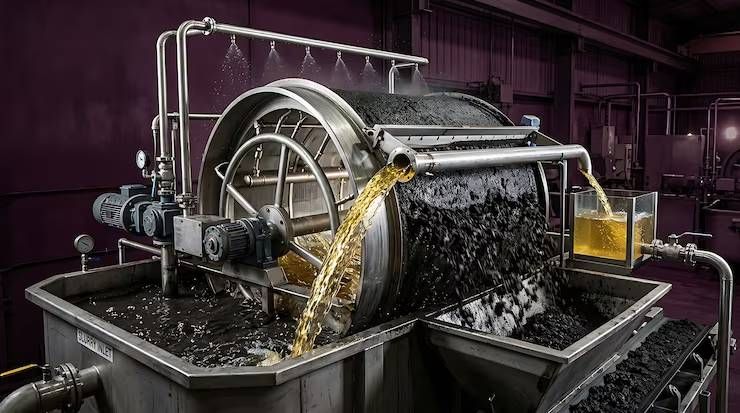
Lubricating oil centrifuge systems are industrial separation systems designed to remove contaminants such as suspended solids, water, sludge, and other unwanted materials from lubricating oils. They combine centrifugal separation equipment with pumps, tanks, heating systems, filtration components, instrumentation, and controls to process contaminated oil.
These systems are used in marine engines, power-generation equipment, industrial gearboxes, compressors, hydraulic machinery, mining equipment, and manufacturing plants. Depending on the application, a lubricating oil centrifuge system can operate continuously or in batches and can be configured for solid-liquid, liquid-liquid, or three-phase separation.
Why Lubricating Oil Centrifuge Systems Matter
Lubricating oils can accumulate contaminants during normal equipment operation. Common contaminants include:
Metal wear particles
Dirt and dust
Carbon deposits
Sludge
Water
Oxidation products
Fine suspended solids
Contamination can affect oil properties and contribute to wear in pumps, bearings, gears, valves, turbines, and other components. Centrifugal separation provides a mechanical method of separating many contaminants from circulating oil.
A complete system can support continuous oil treatment while equipment remains in operation, depending on the system configuration and process requirements.
How Lubricating Oil Centrifuge Systems Work
The basic principle is based on differences in density.
Contaminated oil enters a rotating centrifuge bowl or rotor. High rotational speed generates centrifugal force, causing denser particles and, in suitable systems, water to migrate away from the rotational axis.
The separated phases are discharged through designated outlets or collected for subsequent handling.
System performance depends on:
Centrifugal force
Rotor speed
Oil viscosity
Contaminant density
Particle size
Feed rate
Operating temperature
Residence time
Centrifuge geometry
An integrated heating system may be used to control oil viscosity where required.
Types of Lubricating Oil Centrifuge Systems
Disc Stack Centrifuge Systems
Disc stack centrifuges contain multiple closely spaced conical discs inside a rotating bowl. The discs increase the effective separation surface and allow efficient separation of fine contaminants.
They are commonly used for:
Marine lubricating oils
Turbine oils
Hydraulic oils
Engine oils
Industrial lubricants
Solid-Bowl Centrifuge Systems
Solid-bowl systems are designed primarily for solid-liquid separation. Suspended particles migrate toward the bowl wall and accumulate in the solids-collection area.
These systems can be useful where particulate contamination is the primary concern.
Self-Cleaning Centrifuge Systems
Self-cleaning systems automatically discharge accumulated solids at defined intervals.
This configuration can reduce manual cleaning requirements and support continuous industrial operation.
Manual-Cleaning Systems
Manual-cleaning centrifuges require periodic shutdown and removal of accumulated solids. They can be appropriate for smaller systems or applications with lower contamination loads.
Three-Phase Centrifuge Systems
Three-phase centrifuges can separate oil, water, and solids within a single separation process.
They can be useful when lubricating oil contains both particulate contamination and significant water contamination.
Centrifugal Separation Technologies
Solid-Liquid Separation
Solid-liquid separation removes particles from lubricating oil. Higher-density particles move outward under centrifugal force and can be collected or discharged.
Oil-Water Separation
Oil and water have different densities. A properly configured centrifuge can exploit this difference to separate free water from lubricating oil.
Three-Phase Separation
Three-phase systems can separate:
Lubricating oil
Water
Solid contaminants
This technology is particularly relevant to applications where multiple contamination types occur simultaneously.
High-Speed Centrifugal Separation
Increasing rotational speed increases centrifugal acceleration. High-speed systems can therefore support separation of relatively fine particles, subject to equipment design and operating limitations.
Main Components of a Lubricating Oil Centrifuge System
A complete system generally includes several integrated components.
Centrifuge
The centrifuge provides the primary separation function. Bowl design, rotational speed, disc configuration, and discharge mechanism determine the separation characteristics.
Feed Pump
A feed pump moves contaminated oil from the source tank or equipment circuit into the centrifuge.
Oil Tank
Storage or settling tanks can provide buffer capacity and allow processed oil to be returned to the equipment system.
Heating System
Oil heaters can control viscosity where required for the separation process.
Filtration Equipment
Some installations combine centrifugal separation with filters to capture contaminants that are not efficiently separated by the centrifuge.
Control Panel
A control panel can coordinate pumps, heaters, valves, sensors, alarms, and centrifuge operation.
Instrumentation
Sensors can monitor temperature, pressure, flow, vibration, motor current, and other operating parameters.
Manufacturing Process of Lubricating Oil Centrifuge Systems
Manufacturing these systems involves both precision centrifuge production and skid or system integration.
1. Process Engineering
Engineers establish required throughput, oil characteristics, contamination type, separation objectives, operating temperature, pressure, and automation requirements.
2. Centrifuge Design
The rotating bowl, rotor, discs, shaft, bearings, seals, housing, and discharge mechanism are designed according to the required operating conditions.
3. Material Selection
Materials may include:
Stainless steel
Carbon steel
Cast alloys
Aluminum alloys
Engineering plastics
Specialized corrosion-resistant materials
Material selection depends on oil compatibility, temperature, mechanical loading, and environmental conditions.
4. Precision Machining
Critical rotating components can be manufactured using CNC turning, milling, grinding, boring, and other precision processes.
5. Dynamic Balancing
High-speed rotating assemblies require precise balancing. Dynamic balancing helps control vibration and mechanical loads during operation.
6. System Assembly
The centrifuge is integrated with pumps, tanks, heaters, valves, piping, filters, instrumentation, electrical panels, and control systems.
7. Testing
Testing can include:
Flow testing
Pressure testing
Leakage testing
Vibration testing
Temperature testing
Electrical testing
Centrifuge speed verification
Separation-performance testing
Automated-control testing
Automation and Monitoring
Modern lubricating oil centrifuge systems can use automated controls to regulate the treatment process.
Typical sensors include:
Temperature sensors
Pressure sensors
Flow meters
Vibration sensors
Motor-current sensors
Level sensors
Speed sensors
A PLC can coordinate pumps, heaters, valves, and centrifuge operation. HMIs can provide operators with system status, alarms, operating parameters, and maintenance information.
Industrial communication networks can also connect centrifuge systems with plant-level monitoring platforms.
Lubricating Oil Centrifuge System Comparison
| System Type | Primary Separation | Typical Application |
|---|---|---|
| Disc Stack System | Fine solids and liquid separation | Marine and industrial oils |
| Solid-Bowl System | Solid-liquid separation | Contaminated lubricants |
| Self-Cleaning System | Continuous solid discharge | High-volume applications |
| Manual-Cleaning System | Periodic solid removal | Smaller systems |
| Three-Phase System | Oil, water and solids | Heavily contaminated oils |
| High-Speed System | Fine centrifugal separation | Specialized industrial applications |
Factors Affecting Lubricating Oil Centrifuge System Cost
System cost depends on the centrifuge and the supporting equipment required.
Key factors include:
Processing capacity
Centrifuge type
Bowl speed
Oil viscosity
Separation requirements
Automation level
Tank capacity
Pump specifications
Heating requirements
Filtration requirements
Materials of construction
Instrumentation
Control-panel configuration
Skid design
Installation requirements
A standalone centrifuge can have a very different configuration from a fully integrated automated oil-purification skid.
Global Manufacturers and Suppliers
The market includes centrifuge manufacturers, oil-purification equipment manufacturers, industrial separation companies, system integrators, and specialized distributors.
When evaluating a lubricating oil centrifuge system supplier, organizations can examine:
Processing capacity
Separation efficiency
Oil compatibility
Solid-discharge method
Water-separation capability
Automation options
Material selection
Testing procedures
Spare-parts availability
Maintenance requirements
Technical documentation
For larger industrial facilities, supplier evaluation may also include complete skid design and integration capabilities.
Industrial Applications
Marine Engines
Marine engines use large quantities of lubricating oil and can experience contamination from water, combustion by-products, and mechanical wear. Centrifuge systems can be integrated into onboard oil purification arrangements.
Power Generation
Turbines, generators, and associated rotating equipment rely on lubricating oils. Centrifugal separation can support oil-condition management in power-generation facilities.
Industrial Gearboxes
Gearboxes generate wear particles and can be exposed to moisture and environmental contaminants. Centrifugal systems can support lubricant purification.
Hydraulic Equipment
Hydraulic systems require controlled fluid cleanliness for pumps, valves, and actuators. Centrifugal separation can be incorporated into suitable hydraulic-oil treatment systems.
Compressors
Industrial compressors use lubricating oils for bearings, gears, and other components. Oil purification systems can help manage suspended contaminants and water.
Mining Machinery
Mining equipment operates in dusty and demanding environments. Centrifuge systems can be used in oil-management applications for heavy machinery and processing equipment.
Manufacturing Plants
Manufacturing facilities use lubricating oils in machine tools, gearboxes, compressors, hydraulic equipment, and other production machinery.
How to Select a Lubricating Oil Centrifuge System
1. Analyze the Oil
Determine the lubricant type, viscosity, temperature range, chemical characteristics, and operating conditions.
2. Identify Contaminants
Establish whether the oil contains solids, water, sludge, oxidation products, or combinations of contaminants.
3. Determine Processing Capacity
Calculate required flow rate and total oil volume based on equipment and operating requirements.
4. Choose the Separation Configuration
Select solid-bowl, disc-stack, self-cleaning, three-phase, or another configuration according to separation objectives.
5. Evaluate Temperature Requirements
Determine whether heating is required to maintain appropriate oil viscosity during separation.
6. Consider Automation
Continuous industrial systems may benefit from automated discharge, temperature control, alarms, and sensor-based monitoring.
7. Review Maintenance
Evaluate access to rotating components, seals, bearings, pumps, filters, and discharge mechanisms.
8. Check System Integration
Confirm compatibility with existing tanks, piping, pumps, electrical systems, controls, and plant monitoring infrastructure.
Frequently Asked Questions
What is a lubricating oil centrifuge system?
It is an integrated oil-treatment system that uses centrifugal separation to remove contaminants such as solid particles and water from lubricating oil.
How does a lubricating oil centrifuge system work?
Contaminated oil enters a rotating centrifuge where centrifugal force separates materials according to density. Treated oil is then discharged or returned to the equipment system.
What contaminants can these systems remove?
Depending on the centrifuge design, systems can separate suspended solids, wear particles, sludge, and free water from lubricating oil.
What is a three-phase lubricating oil centrifuge?
A three-phase centrifuge is designed to separate three components, typically oil, water, and solid contaminants, within one centrifugal separation process.
Where are lubricating oil centrifuge systems used?
They are used in marine engines, power-generation equipment, industrial gearboxes, compressors, hydraulic systems, mining machinery, and manufacturing facilities.
Conclusion
Lubricating oil centrifuge systems combine centrifugal separation technology with pumps, tanks, heating systems, filtration equipment, instrumentation, and control systems to manage contamination in industrial lubricants.
Disc-stack, solid-bowl, self-cleaning, high-speed, and three-phase configurations can address different separation requirements. Modern systems can also incorporate PLC control, sensors, automated discharge, temperature regulation, and condition monitoring.
Selecting an appropriate system requires consideration of oil characteristics, contamination type, processing capacity, separation objectives, operating temperature, automation, maintenance, and integration with existing industrial equipment.