Slitting machines are industrial machines designed to divide wide rolls or sheets of material into narrower strips with specified widths. They are widely used in metal processing, paper production, plastics manufacturing, packaging, electrical materials, textiles, and converting industries.
These machines use cutting tools, controlled material feeding, and tension-management systems to produce strips that meet defined dimensional and production requirements. Depending on the material and application, slitting equipment may process steel coils, aluminum foil, paper rolls, plastic films, adhesive laminates, and other flexible or semi-rigid materials.
Context
What Are Slitting Machines?
A slitting machine cuts a wide web, sheet, or coil into narrower sections. In roll-to-roll processing, the material is unwound from a parent roll, guided through the cutting section, and divided into strips. The strips may then be rewound into individual coils or rolls for storage and subsequent manufacturing operations.
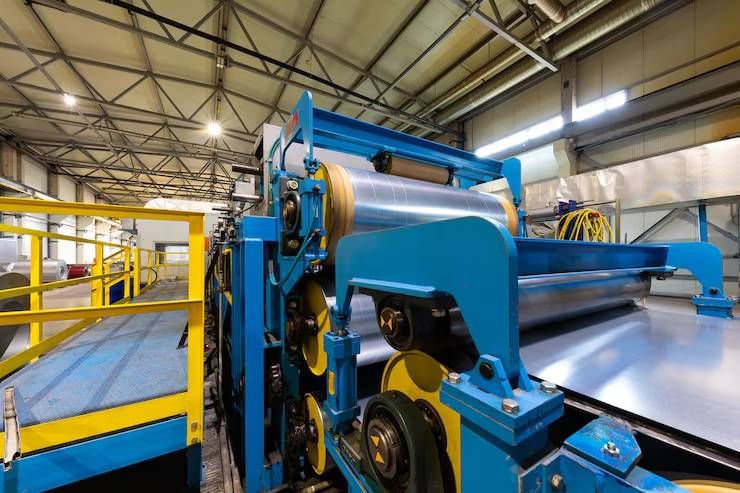
A typical roll slitting line includes an unwinding unit, material-guiding system, cutting station, tension-control equipment, and rewinding or discharge section. Depending on the material, the machine may also contain edge-trimming equipment, inspection sensors, automatic knife positioning, and scrap removal mechanisms.
Slitting performance depends on material thickness, tensile strength, flexibility, surface properties, required strip width, cutting tolerance, and production speed. Tool geometry and clearance are especially important when processing metals, while blade condition and web tension can strongly influence the quality of thin films and paper.
Major Types of Slitting Machines
1. Metal Coil Slitting Machines
Metal coil slitting machines process wide coils of steel, stainless steel, aluminum, copper, and other metals. Circular rotary knives cut the coil into narrower strips, which are commonly recoiled for downstream manufacturing.
These lines may include heavy-duty decoilers, coil cars, leveling equipment, rotary shear assemblies, scrap winders, separators, and recoilers. Their design depends on coil weight, strip width, metal thickness, and the required edge quality.
2. Paper Slitting Machines
Paper slitting machines divide large paper rolls into narrower rolls or sheets. They are used in printing, stationery, tissue production, label manufacturing, and packaging. Depending on the equipment, cutting may use rotary knives, razor blades, or shear-cutting arrangements.
3. Plastic Film Slitting Machines
Film slitters process materials such as polyethylene, polypropylene, polyester, and other polymer films. Precise tension control is important because thin films can stretch, wrinkle, curl, or tear during processing.
These machines are used in flexible packaging, protective films, laminates, industrial films, and selected electronic materials.
4. Foil Slitting Machines
Foil slitters process thin aluminum and other metal foils. Their cutting systems are designed to manage delicate materials while limiting burrs, wrinkles, edge deformation, and surface damage. Applications include packaging, insulation, electrical components, and battery-related materials.
5. Shear Slitting Machines
Shear slitting uses two circular knives that overlap or pass close to one another in a controlled arrangement. It is widely used for metal strip and other materials where a defined cutting action and consistent edge condition are required.
Knife overlap, clearance, sharpness, and alignment influence the resulting cut.
6. Razor Slitting Machines
Razor slitting uses thin blades to cut suitable flexible materials. It is commonly used for certain plastic films, lightweight laminates, and other thin web materials. Blade positioning and web stability influence cut consistency.
7. Crush Slitting Machines
Crush slitting uses a hardened circular blade that presses the material against a suitable anvil roller. It is used for selected paper, nonwoven, foam, and flexible web materials. Suitability depends on the material's thickness, compressibility, and required edge condition.
8. Rewinding and Slitting Machines
Slitter-rewinders combine cutting with winding operations. The parent roll is slit into multiple narrower webs, which are then wound onto separate cores. These machines are common in packaging, label stock, adhesive materials, paper converting, and film production.
Slitting Technologies
Rotary Shear Slitting: Circular upper and lower knives create a shearing action. This technology is widely used for metal coils and other materials requiring controlled edge separation.
Razor Slitting: A blade cuts a flexible web along a defined line. The method is suitable for selected thin films and lightweight materials.
Crush Cutting: A circular knife presses material against an anvil or hardened roller. It is frequently used for compressible or flexible materials when appropriate edge requirements can be achieved.
Laser Slitting: Laser systems use concentrated optical energy to separate suitable materials. Depending on the material and application, laser processing can provide narrow cutting paths, although thermal effects and edge characteristics must be evaluated.
Automatic Knife Positioning: Motorized systems position slitting knives according to programmed strip widths. This can reduce manual setup effort and support repeatable production settings.
Closed-Loop Tension Control: Sensors and control systems regulate tension during unwinding, slitting, and rewinding. This is important for preventing wrinkles, telescoping rolls, strip breaks, and inconsistent winding.
Comparison of Slitting Machine Types
| Machine type | Main technology | Common applications |
|---|---|---|
| Metal coil slitter | Rotary shear cutting | Steel, stainless steel, and aluminum coils |
| Paper slitter | Rotary, razor, or shear cutting | Printing and paper converting |
| Film slitter | Razor or shear cutting | Flexible packaging and polymer films |
| Foil slitter | Precision rotary cutting | Aluminum foil and thin metal materials |
| Shear slitter | Two-knife shearing action | Metal strips and selected web materials |
| Crush slitter | Blade and anvil pressure | Paper, foam, and nonwoven materials |
| Slitter-rewinder | Cutting with separate winding stations | Labels, films, laminates, and paper rolls |
Importance of Slitting Machines
Slitting machines help manufacturers convert large parent rolls into narrower formats suited to specific production requirements. This allows material suppliers and processors to prepare feedstock for stamping, printing, lamination, packaging, roll forming, and other manufacturing operations.
Accurate slit widths can improve material utilization and simplify downstream alignment. Consistent edge quality is also important because damaged edges may cause web breaks, feeding problems, uneven winding, or defects in subsequent processing.
For metal coils, slitting supports the preparation of strip stock used in stamping, tube manufacturing, electrical components, and industrial fabrication. For films and paper, the process helps produce rolls compatible with printing presses, laminators, packaging lines, and converting equipment.
The achievable results depend on material properties, cutting-tool geometry, machine rigidity, alignment, tension settings, and operator control. Slitting does not automatically eliminate defects already present in the parent material, so incoming material inspection remains important.
Manufacturing Processes
Machine Design and Engineering
Slitting machine manufacturing begins with defining the material type, thickness range, parent-roll dimensions, strip-width requirements, cutting tolerance, operating speed, and winding configuration.
Engineers select the frame structure, cutting technology, spindle arrangement, drive system, tension controls, and automation architecture. Heavy metal coil slitters require strong frames and substantial coil-handling equipment, while thin-film machines place greater emphasis on precise web guiding and tension stability.
Frame and Structural Manufacturing
The machine frame is manufactured from suitable structural materials through processes such as cutting, machining, welding, and surface finishing. Mounting surfaces for the cutting shafts and guide systems require appropriate dimensional accuracy.
Frame rigidity helps maintain the alignment of cutting tools during operation. In heavy-duty systems, structural design must accommodate coil loads, cutting forces, and the dynamic effects of high-speed material movement.
Shaft and Knife Production
Slitting shafts and knife holders are produced with controlled dimensions and surface finishes. Rotary knives are manufactured from suitable tool steels or other materials selected for hardness, wear resistance, and compatibility with the material being cut.
Depending on the knife design, production may involve heat treatment, precision grinding, edge finishing, and dimensional inspection. Sharpness, concentricity, knife clearance, and alignment influence cutting quality and tool life.
Drive and Tension-Control Assembly
Motors, gearboxes, couplings, brakes, and drive rolls are assembled to regulate material movement. Unwinding and rewinding stations must accommodate changes in roll diameter and inertia as material is processed.
Tension-control systems may use load cells, dancer rolls, torque controls, and coordinated motor drives. These components help maintain appropriate tension across different operating conditions.
Automation and Electrical Integration
Electrical systems include control panels, sensors, safety devices, variable-frequency drives, and programmable logic controllers. Human-machine interfaces allow operators to set strip widths, line speeds, tension parameters, and winding configurations.
Advanced systems may include automatic knife positioning, recipe storage, roll-diameter measurement, web-edge guiding, and production data recording. Integration depends on the required level of automation and the material being processed.
Assembly, Calibration, and Testing
After mechanical and electrical assembly, the machine undergoes checks for shaft alignment, knife positioning, drive operation, tension control, guarding, and emergency-stop functions.
Trial runs using representative materials help assess strip width, edge condition, winding quality, surface damage, and operating stability. Testing procedures should reflect the machine specification and the intended production environment.
Global Manufacturers and Suppliers
The slitting machine market includes manufacturers specializing in metal coil processing, paper converting, flexible packaging, and precision web handling. Their equipment portfolios vary by material type, roll dimensions, production speed, and automation level.
Examples of recognized manufacturers and equipment providers include:
ANDRITZ: Supplies industrial processing technologies and equipment, including systems associated with metal processing and coil handling.
FIMI: Specializes in metal coil processing lines, including slitting and cut-to-length equipment.
Athader: Develops coil-processing machinery and slitting lines for metal strip applications.
KAMPF: Provides slitting and winding technology for flexible materials, including films and related web products.
Atlas Converting Equipment: Specializes in slitter-rewinders for flexible packaging films and other web materials.
ASHE Converting Equipment: Develops slitting and rewinding equipment for paper, film, foil, and related converting applications.
Parkinson Technologies: Supplies winding and web-handling equipment for selected industrial material-processing applications.
Bimec: Produces slitter-rewinders and converting machinery for flexible materials.
These companies operate across different segments of the market, and not every manufacturer produces all machine types. Current product configurations, material capabilities, and regional availability should be confirmed directly.
When evaluating manufacturers or suppliers, consider material compatibility, parent-roll diameter, maximum roll weight, strip-width range, cutting tolerance, production speed, winding configuration, knife technology, tension control, automation, and installation requirements.
Other important factors include operator training, commissioning, spare knife availability, maintenance procedures, technical documentation, and integration with upstream and downstream production lines.
Industrial Applications
Metal Processing and Steel Manufacturing
Metal service centers use coil slitting machines to divide wide steel, stainless steel, and aluminum coils into narrower strips. These strips are supplied to stamping plants, fabricators, tube mills, and component manufacturers.
Automotive Manufacturing
Slit metal strips are used in selected automotive components, brackets, structural parts, electrical components, and formed products. Width consistency and edge quality can influence downstream forming and assembly.
Flexible Packaging
Packaging manufacturers use film and laminate slitters to prepare material for pouch-making, wrapping, sealing, printing, and converting operations. Tension control and surface protection are important when handling thin or multilayer materials.
Paper and Printing
Paper slitters prepare rolls for printing presses, label production, stationery manufacturing, and packaging. The selected cutting method depends on paper grade, thickness, roll dimensions, and required output format.
Electrical and Electronic Materials
Slitting machines process selected copper foils, aluminum foils, insulating films, and other materials used in electrical and electronic products. Precision handling can be important for narrow strips and delicate surfaces.
Battery Manufacturing
Certain battery production processes require narrow metal foils and coated electrode materials. Specialized slitting equipment can divide these materials into specified widths while controlling edge damage, particles, burrs, and coating integrity. Requirements depend on the electrode material and battery design.
Textiles and Nonwoven Materials
Slitting equipment converts wide rolls of textile webs, nonwovens, foam laminates, and related materials into narrower rolls for filtration, hygiene products, insulation, and industrial applications.
Adhesive Tapes and Labels
Slitter-rewinders convert wide rolls of adhesive-coated materials into narrower tape rolls and label stock. Web tension, blade selection, adhesive behavior, and winding accuracy affect the finished roll quality.
Recent Developments
Slitting machine technology continues to develop through automated knife positioning, improved tension regulation, digital monitoring, and more coordinated winding systems. These technologies can reduce setup variation and help maintain stable processing conditions across different materials.
Servo-driven controls and stored production recipes allow operators to repeat settings for recurring strip widths and material types. Automatic web guiding can correct lateral movement, while roll-diameter sensors help coordinate unwinding and rewinding.
Manufacturers are also incorporating condition monitoring and production data collection. These features can help identify recurring edge defects, abnormal drive loads, tension variation, and maintenance requirements.
In precision applications, equipment design increasingly emphasizes reduced material damage, cleaner edges, and careful management of particles and burrs. The practical results depend on knife geometry, machine configuration, material properties, and operating conditions.
Laws or Policies
Slitting machines must meet applicable machinery-safety, electrical, workplace, and environmental requirements in their installation region.
Rotating knives, exposed shafts, moving webs, nip points, heavy coils, and powered rewinders create significant hazards. Suitable guarding, emergency-stop systems, safe access arrangements, and documented operating procedures are essential. Maintenance should follow appropriate isolation and lockout procedures.
Electrical systems and machine controls should comply with relevant local regulations and applicable machinery-safety standards. Coil-handling equipment, lifting devices, and roll supports must be suitable for the loads involved.
Facilities processing metal, paper, films, or coated materials may also need to manage dust, scrap, noise, lubricants, solvents, or coating residues. Environmental controls depend on the material and production process.
Manufacturers and operators should verify current legal requirements and ensure that machine installation, training, inspection, and maintenance arrangements are appropriate for the intended application.
Tools and Resources
Manufacturer documentation: Technical specifications, operating manuals, knife diagrams, and maintenance schedules help determine whether a machine suits the material and production requirements.
Width and dimensional measurement: Calipers, micrometers, precision rulers, and suitable optical measurement systems help verify slit width and dimensional consistency.
Knife inspection tools: Inspection equipment can help assess blade condition, edge wear, alignment, and other factors affecting cut quality.
Web tension monitoring: Load cells, tension sensors, and control-system records help identify tension variation during unwinding, slitting, and rewinding.
Roll quality inspection: Suitable measuring equipment can assess roll width, winding alignment, telescoping, wrinkles, and other visible defects.
Production monitoring software: Control systems and manufacturing software can record machine settings, material batches, production output, alarms, and quality results.
Technical standards: Applicable machinery-safety, electrical, material-handling, and product specifications provide guidance for safe operation and production quality.
FAQs
1. What is a slitting machine used for?
A slitting machine divides wide rolls or sheets into narrower strips. It is used in metal processing, paper converting, flexible packaging, plastics manufacturing, electrical materials, textiles, and other industries.
2. What is the difference between shear slitting and razor slitting?
Shear slitting uses two circular knives that act against one another to cut material. Razor slitting uses a thin blade to cut suitable flexible materials. The appropriate method depends on material thickness, flexibility, edge requirements, and production conditions.
3. Which materials can be processed using slitting machines?
Depending on the equipment, materials include steel, stainless steel, aluminum, copper, paper, plastic films, foil, laminates, adhesives, nonwovens, and selected coated materials. Each material requires an appropriate cutting method and tension-control arrangement.
4. What factors affect slitting quality?
Important factors include material properties, knife sharpness, blade alignment, cutting clearance, web tension, line speed, shaft condition, and winding settings. Proper setup and regular inspection help maintain consistent strip width and edge quality.
5. What should manufacturers consider when selecting a slitting machine?
Manufacturers should assess the material type, thickness, parent-roll dimensions, strip-width range, required cutting tolerance, production speed, winding arrangement, automation, safety features, and integration with existing production lines. Technical support and maintenance requirements should also be considered.
Conclusion
Slitting machines are important industrial systems for converting wide rolls and sheets into narrower strips suitable for downstream production. Different cutting technologies and machine configurations support applications ranging from heavy metal coil processing to delicate films, paper, foils, and adhesive materials.
Understanding machine types, cutting methods, tension control, manufacturing processes, and equipment capabilities helps manufacturers select appropriate systems for their production requirements. Continued improvements in automation, digital monitoring, and precision web handling are supporting more consistent slitting operations across industrial sectors.