Stepper motors are electric motors designed to move in precise, fixed increments known as steps. Unlike conventional electric motors that rotate continuously, stepper motors can stop, start, and position their shafts accurately without requiring continuous feedback in many applications. This precise movement makes them an important component in motion control technologies used across manufacturing, automation, robotics, medical equipment, and electronics.
Modern stepper motors work alongside motor drive systems, programmable controllers, sensors, and computer-based automation platforms to achieve accurate positioning and repeatable motion. Advances in manufacturing technologies and digital control have expanded their use in industrial applications where precision, reliability, and synchronized movement are important.
As Industry 4.0 continues to influence manufacturing, stepper motors are increasingly integrated into smart automation systems, machine vision equipment, and digital production environments for improved control and monitoring.
Context
What Are Stepper Motors?
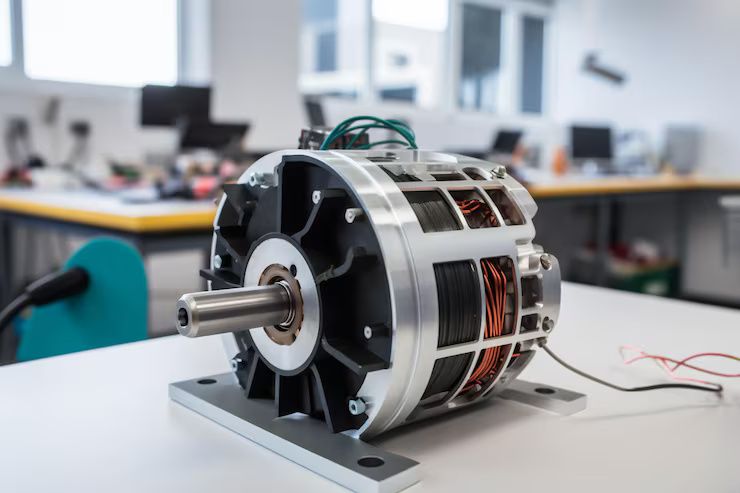
A stepper motor is a brushless synchronous electric motor that rotates in a series of controlled angular steps. Each electrical pulse sent from a controller causes the motor shaft to move by a specific angle, allowing highly accurate positioning.
Unlike traditional motors that require continuous rotation control, stepper motors respond directly to pulse signals generated by a motor drive or motion controller.
Typical components include:
- Rotor
- Stator
- Windings
- Bearings
- Shaft
- Housing
- Electrical connectors
Together, these components convert electrical pulses into controlled mechanical movement.
How Stepper Motors Work
Stepper motors operate by energizing internal coils in a specific sequence. The magnetic fields generated by these coils attract the rotor, causing it to rotate one step at a time.
The operating sequence generally includes:
- A motion controller generates pulse signals.
- The motor driver amplifies these signals.
- Windings are energized in sequence.
- The rotor moves by a fixed angle.
- Repeated pulses create continuous controlled rotation.
Changing the pulse frequency controls motor speed, while changing the pulse count controls movement distance.
Common Types of Stepper Motors
Several stepper motor designs are available for different motion control requirements.
| Stepper Motor Type | Main Characteristics | Typical Applications |
|---|---|---|
| Permanent Magnet Stepper Motor | Simple construction and moderate precision | Consumer devices |
| Variable Reluctance Stepper Motor | Lightweight rotor with rapid response | Positioning equipment |
| Hybrid Stepper Motor | High accuracy and strong holding torque | CNC machines, robotics |
| Linear Stepper Motor | Produces straight-line movement | Automation systems |
| Closed-Loop Stepper Motor | Uses position feedback | Precision industrial equipment |
Each type is selected according to speed, torque, positioning accuracy, and application requirements.
Motion Control Technologies
Stepper motors form part of larger motion control systems.
These systems commonly include:
- Motion controllers
- Stepper motor drivers
- Power supplies
- Position sensors
- PLCs
- Human-machine interfaces (HMIs)
- Industrial communication networks
Together, these technologies coordinate machine movement throughout automated production.
Importance
Why Stepper Motors Matter
Many industrial processes require equipment to stop at exact positions repeatedly. Stepper motors provide accurate incremental movement, making them suitable for applications involving positioning, indexing, dispensing, printing, and automated assembly.
Their predictable motion simplifies machine control in many automation systems.
Supporting Industrial Automation
Industrial automation relies on stepper motors to control machine movement with precision.
Common automated functions include:
- Positioning tools
- Moving conveyor mechanisms
- Operating pick-and-place systems
- Controlling packaging equipment
- Managing laboratory instruments
- Driving inspection systems
Accurate movement helps maintain consistent production quality.
Applications Across Industries
Stepper motors are widely used in numerous industries.
Manufacturing: CNC machines, automated assembly systems, and production equipment use stepper motors for positioning operations.
Medical Equipment: Laboratory analyzers, diagnostic instruments, and medical devices use controlled motor movement.
Electronics Manufacturing: Precision component placement systems rely on stepper motors during circuit board assembly.
Printing: Industrial printers use stepper motors to position print heads and transport materials.
Robotics: Robotic arms and automated handling equipment perform controlled movement using stepper motor drive systems.
Advantages of Stepper Motors
Stepper motors provide several operational advantages.
These include:
- Precise positioning
- Repeatable movement
- Accurate speed control
- High holding torque at low speeds
- Simple digital control
- Compatibility with automation systems
Performance depends on proper motor sizing, drive configuration, and operating conditions.
Recent Updates
Closed-Loop Motion Control
Between 2024 and 2026, closed-loop stepper motor systems have become increasingly common. These systems use position feedback to improve accuracy, reduce missed steps, and enhance operational efficiency in demanding applications.
Closed-loop technology combines traditional stepper motor control with encoder feedback for improved motion performance.
Industry 4.0 Integration
Modern motion control technologies increasingly connect stepper motors with industrial automation platforms and digital monitoring systems.
Connected systems support:
- Remote diagnostics
- Equipment monitoring
- Predictive maintenance
- Performance analysis
- Production optimization
These capabilities improve operational visibility across manufacturing facilities.
Advanced Motor Drivers
Motor drive technology continues to evolve with improved microstepping, smoother motion profiles, and better energy management.
Modern drive systems help reduce vibration, minimize noise, and improve positioning accuracy during machine operation.
Compact High-Torque Designs
Manufacturers continue developing compact stepper motors capable of producing greater torque while maintaining precise positioning. These designs support equipment where installation space is limited.
Artificial Intelligence in Motion Systems
Artificial intelligence is increasingly used alongside motion control platforms to analyze equipment performance, identify operating patterns, and support maintenance planning based on operational data.
Laws or Policies
Electrical Safety Standards
Stepper motors and drive systems are manufactured according to internationally recognized electrical safety and quality standards that address equipment performance, insulation, and operational safety.
Machinery Safety Regulations
Industrial equipment using motion control technologies operates under workplace safety regulations governing machine design, emergency stopping systems, guarding, and electrical protection.
Organizations typically implement documented safety procedures for installation and maintenance.
Electromagnetic Compatibility
Motor controllers and electronic drive systems are designed to meet electromagnetic compatibility requirements that reduce electrical interference with surrounding equipment.
Compliance requirements vary according to country and industrial application.
Energy Efficiency Considerations
Many industries evaluate energy-efficient motor technologies when designing automation equipment. Improvements in drive electronics and motion control software contribute to more efficient system operation.
Tools and Resources
Motion Control Software
Engineering software is widely used to configure motion profiles, program positioning sequences, and monitor motor performance.
Typical functions include:
- Motion programming
- Speed adjustment
- Position control
- Diagnostic monitoring
- System configuration
CAD Software
Computer-aided design platforms help engineers develop mechanical assemblies, motor mounts, and automated machine layouts before production.
PLC Programming Platforms
Programmable Logic Controller software integrates stepper motors with sensors, industrial robots, conveyors, and production equipment.
Motion Simulation Tools
Simulation software allows engineers to evaluate machine movement before physical installation.
Simulation can support:
- Position verification
- Motion analysis
- Cycle optimization
- Mechanical interference checks
Educational Resources
People interested in stepper motors and motion control technologies can learn from:
- Industrial automation organizations
- Motion control engineering publications
- Robotics associations
- Manufacturing technology journals
- Electrical engineering standards organizations
- Technical training materials
These resources explain motor operation, control principles, drive systems, and industrial applications.
FAQs
What is a stepper motor?
A stepper motor is a brushless electric motor that moves in precise angular steps, allowing accurate positioning and controlled motion in automated equipment.
What are the main types of stepper motors?
The most common types are permanent magnet, variable reluctance, hybrid, linear, and closed-loop stepper motors. Each is designed for specific motion control requirements.
How do stepper motor drive systems work?
Stepper motor drive systems receive pulse signals from a controller, energize the motor windings in sequence, and move the motor shaft by fixed increments for precise positioning.
Where are stepper motors used?
Stepper motors are widely used in CNC machines, robotics, medical equipment, packaging machinery, industrial automation, printers, laboratory instruments, and electronic manufacturing systems.
Why are stepper motors important in industrial applications?
Stepper motors provide accurate positioning, repeatable movement, controlled speed, and reliable operation, making them valuable for automated manufacturing and precision motion control technologies.
Conclusion
Stepper motors are fundamental components of modern motion control technologies, providing precise and repeatable movement across a wide range of industrial applications. Combined with advanced drive systems, programmable controllers, and digital automation platforms, they support accurate positioning and efficient machine operation. As manufacturing continues to adopt smart technologies and connected automation, stepper motors remain an important part of industrial equipment requiring dependable motion control.