Coffee roasting machines are industrial and commercial systems used to transform green coffee beans into roasted coffee through controlled application of heat. The roasting process changes the beans' color, aroma, flavor, density, moisture content, and physical structure.
Modern coffee roasters range from small commercial batch machines to large automated industrial systems. Their configuration depends on batch capacity, roasting technology, fuel source, automation level, heat-transfer method, cooling requirements, and production objectives.
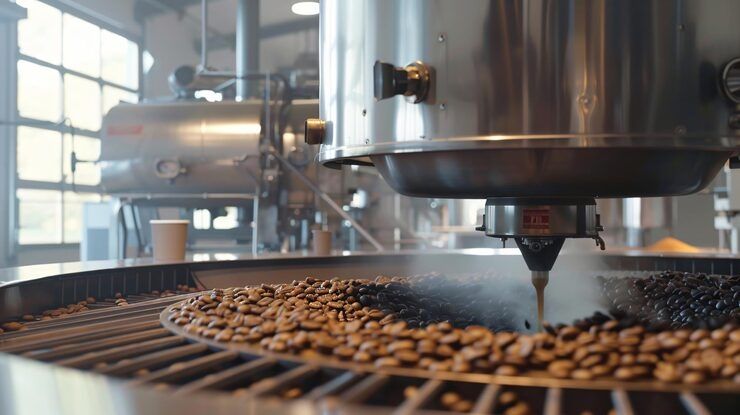
Why Coffee Roasting Machines Matter
Roasting is one of the most important stages in coffee production because controlled heat treatment influences the characteristics of the finished beans. A roasting machine must provide consistent heat transfer while allowing operators or automated systems to manage temperature, airflow, roasting time, and cooling.
A typical roasting system may include:
- Green coffee bean loading system
- Preheating system
- Roasting chamber
- Heating system
- Airflow controls
- Temperature sensors
- Agitation mechanism
- Exhaust system
- Chaff collection
- Cooling tray
- Control panel
- Batch discharge system
Industrial systems can also incorporate automated green-bean handling, recipe management, data logging, and integration with grinding and packaging equipment.
Coffee Roasting Technologies
Coffee roasting machines use different heat-transfer technologies. The choice affects how beans move through the roasting chamber and how heat reaches the coffee.
Drum Roasting Technology
Drum roasters use a rotating cylindrical chamber to continuously agitate coffee beans during roasting. Heat can be transferred through a combination of conduction, convection, and radiation.
Drum roasting is widely used in specialty, commercial, and industrial coffee production because the technology can support controlled roasting profiles across different batch sizes.
Fluid-Bed Roasting Technology
Fluid-bed roasters use heated air to suspend and circulate coffee beans inside the roasting chamber.
The strong airflow provides significant convective heat transfer and can support relatively fast roasting. Fluid-bed systems are used across different commercial applications, particularly where airflow control and rapid heat transfer are important.
Hot-Air Roasting
Hot-air systems rely primarily on heated air to transfer energy to the beans. The technology can provide rapid and controlled heating, although machine design, airflow, bean movement, and roasting profile all influence the final result.
Continuous Roasting
Continuous roasting systems are designed for high-throughput production rather than individual small batches. Green beans move continuously through controlled roasting zones.
These systems can be integrated with automated material handling and cooling equipment for large-scale coffee production.
Major Types of Coffee Roasting Machines
| Machine Type | Main Function | Typical Application |
|---|---|---|
| Drum Roaster | Rotates beans inside a heated drum | Commercial and industrial roasting |
| Fluid-Bed Roaster | Uses heated air to move beans | Commercial and specialty applications |
| Hot-Air Roaster | Transfers heat primarily through airflow | Controlled rapid roasting |
| Batch Roaster | Roasts a defined quantity per cycle | Cafés and commercial facilities |
| Continuous Roaster | Processes beans continuously | Large-scale production |
| Sample Roaster | Roasts small quantities for evaluation | Quality control and product development |
| Electric Roaster | Uses electrical heating | Small and medium-scale applications |
| Gas Roaster | Uses gas-fired heating | Commercial and industrial production |
| Automated Roaster | Uses computerized controls | Repeatable commercial production |
| Industrial Coffee Roaster | Handles large production volumes | Large-scale coffee manufacturing |
Coffee Roasting Manufacturing Process
Although machine designs vary, a generalized coffee roasting process follows several stages:
Green Coffee Receiving → Cleaning → Storage → Bean Feeding → Preheating → Roasting → Temperature and Airflow Control → First Crack → Desired Roast Development → Discharge → Cooling → Chaff Separation → Quality Inspection → Grinding or Packaging
Not every facility follows exactly the same sequence. Some plants integrate cleaning, sorting, blending, grinding, degassing, and packaging into a larger automated coffee-processing system.
1. Green Bean Preparation
Green coffee beans are received, inspected, cleaned, and stored before roasting. Foreign materials and unwanted particles may be removed through cleaning and separation systems.
2. Bean Loading
A measured quantity of green coffee is transferred into the roasting chamber. Batch size depends on the machine's rated capacity.
3. Roasting
Heat is applied while the beans are agitated. Operators or automated controls monitor variables such as bean temperature, air temperature, airflow, and roasting time.
4. Roast Development
As roasting progresses, chemical and physical changes occur inside the beans. The desired roast profile depends on the coffee variety, processing method, product specification, and intended flavor characteristics.
5. Discharge and Cooling
Once the target roast is reached, beans are discharged from the roasting chamber into a cooling system. Rapid cooling helps stop further roasting and stabilize the beans.
Roasting Profiles and Process Control
Modern coffee roasting machines increasingly use digital control systems to manage roasting profiles.
A roasting profile may include:
- Initial charge temperature
- Heating rate
- Bean temperature
- Air temperature
- Airflow
- Roasting duration
- Rate of temperature change
- Discharge temperature
- Cooling duration
Automated controls can store roasting recipes and reproduce defined process parameters across batches.
Advanced systems may also provide data logging, remote monitoring, alarms, automatic burner adjustment, and integration with production-management systems.
Chaff Collection and Exhaust Systems
Roasting produces chaff, which is the lightweight material separated from the coffee bean during roasting. Roasters therefore commonly incorporate cyclones, filters, collectors, or other separation equipment.
Exhaust systems remove hot air and roasting gases from the machine. Proper exhaust design is important for maintaining airflow, managing heat, and supporting a suitable production environment.
The exhaust configuration should be designed according to the machine, facility, local requirements, and applicable environmental and safety standards.
Coffee Roasting Equipment Costs and Pricing Factors
The coffee roasting machine cost varies considerably depending on capacity, technology, heating method, automation, construction materials, controls, exhaust configuration, and additional equipment.
A small commercial batch roaster has a very different equipment specification from a high-throughput continuous industrial roasting line.
When evaluating coffee roaster machine pricing, consider the complete system requirements, including:
- Roaster capacity
- Heating system
- Cooling equipment
- Green-bean loading
- Chaff collection
- Exhaust system
- Automation and controls
- Installation requirements
- Electrical or gas infrastructure
- Maintenance requirements
The purchase specification should therefore be based on production requirements rather than machine capacity alone.
How to Select Coffee Roasting Machines
1. Determine Production Capacity
Estimate the required roasted coffee output per hour or per day. This helps determine whether a batch or continuous system is appropriate.
2. Select the Roasting Technology
Compare drum, fluid-bed, hot-air, and continuous systems according to the desired roasting profile and production environment.
3. Consider Heat Source
Common heating configurations include gas and electric systems. The available utilities, operating requirements, controls, and facility infrastructure should be evaluated.
4. Evaluate Automation
Consider whether manual operation, programmable controls, automated profiles, or fully integrated production controls are appropriate.
5. Examine Cooling Capacity
Cooling should be compatible with the roasting machine's throughput. Insufficient cooling capacity can affect production flow and roast consistency.
6. Check Exhaust and Chaff Management
The roaster should have an appropriate system for managing chaff, smoke, heat, and exhaust.
7. Consider Maintenance and Serviceability
Accessible components, replacement parts, cleaning requirements, and maintenance procedures can influence long-term machine operation.
Global Coffee Roasting Machine Manufacturers and Suppliers
The global coffee equipment market includes manufacturers supplying commercial roasters, industrial roasting systems, automation technologies, and integrated coffee-processing lines.
Probat develops coffee roasting technologies and equipment for different production scales, including industrial applications.
Bühler supplies processing technologies for coffee and other food industries, including roasting and related processing systems.
Diedrich Roasters produces coffee roasting equipment used in commercial and specialty coffee applications.
Giesen Coffee Roasters manufactures coffee roasting machines for commercial and specialty roasting operations.
Loring Smart Roast develops coffee roasting systems with automated controls and heat-management technologies.
Other manufacturers and equipment suppliers operate across different segments of the coffee-roasting market, ranging from small commercial machines to large industrial systems. Selection should be based on machine capacity, roasting technology, automation, facility requirements, and production objectives.
Industrial Applications of Coffee Roasting Machines
Coffee roasting equipment is used across a broad range of production environments.
Coffee Manufacturing Plants
Large coffee manufacturers use industrial roasters to process substantial quantities of green coffee for packaged coffee products.
Specialty Coffee Roasting
Specialty roasters often use programmable batch machines to develop and reproduce specific roasting profiles.
Coffee Blending
Roasting equipment can be incorporated into production systems where different coffee origins or varieties are processed separately or according to defined blending strategies.
Ground Coffee Production
Roasting machines may form part of an integrated line that includes cooling, grinding, sieving, storage, degassing, and packaging.
Instant Coffee Production
Industrial coffee roasting is also an upstream stage in instant coffee manufacturing, followed by extraction, concentration, drying, and packaging processes.
Frequently Asked Questions
What is a coffee roasting machine?
A coffee roasting machine is equipment designed to heat green coffee beans under controlled conditions until they reach the desired roast profile. The machine controls variables such as heat, airflow, agitation, and roasting time.
What are the main types of coffee roasting machines?
Major types include drum roasters, fluid-bed roasters, hot-air roasters, batch roasters, continuous roasters, electric roasters, gas roasters, and automated industrial coffee roasters.
How does a coffee roasting machine work?
The machine heats and agitates green coffee beans while controlling variables such as temperature and airflow. Once the desired roast level is reached, the beans are discharged and rapidly cooled.
How much does a coffee roasting machine cost?
Coffee roasting machine costs vary according to capacity, technology, heating method, automation, controls, exhaust equipment, and configuration. Small commercial machines and industrial systems can have substantially different specifications.
How do I choose an industrial coffee roaster?
Consider production capacity, roasting technology, heating method, automation, cooling capacity, exhaust requirements, facility infrastructure, maintenance needs, and the desired roasting profile.
Conclusion
Coffee roasting machines combine controlled heat transfer, bean agitation, airflow management, exhaust handling, and cooling to transform green coffee into roasted beans. Drum, fluid-bed, hot-air, batch, and continuous technologies provide different approaches for commercial and industrial production.
The right machine depends on production capacity, desired roasting profiles, automation requirements, energy source, cooling performance, exhaust configuration, and overall plant design. Evaluating these factors together can help coffee processors select equipment that aligns with their production process and application requirements.