Industrial chillers are refrigeration systems designed to remove heat from process fluids and maintain controlled temperatures for industrial equipment and production operations. They are used across manufacturing, plastics processing, pharmaceuticals, food processing, chemical production, metalworking, electronics, data infrastructure, and other temperature-sensitive applications.
An industrial chiller typically transfers heat from a process fluid to another medium through a refrigeration cycle or alternative cooling technology. System configuration depends on required cooling capacity, operating temperature, ambient conditions, fluid characteristics, heat load, and installation environment.
Context
What Is an Industrial Chiller?
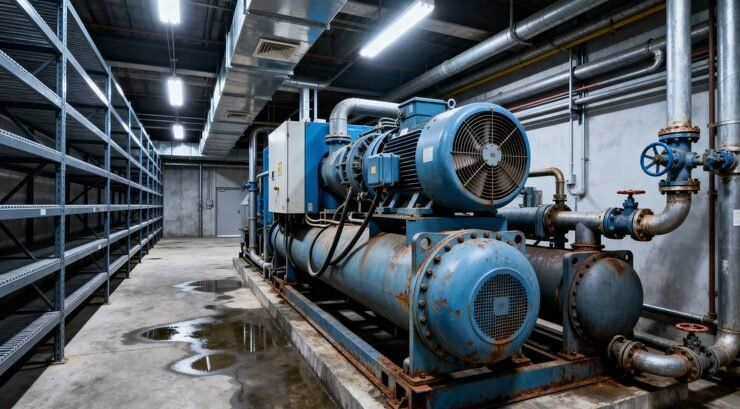
An industrial chiller is a cooling system that extracts heat from water, glycol mixtures, oil, or another process fluid. The cooled fluid is then circulated to machinery, production equipment, heat exchangers, or controlled process areas.
A conventional vapor-compression chiller generally includes a compressor, condenser, expansion device, and evaporator. Refrigerant circulates through these components while absorbing heat from the process fluid and releasing it to the surrounding environment.
Industrial chillers can be designed as air-cooled, water-cooled, evaporative, or specialized systems. They can also be configured for low-temperature applications where conventional chilled-water systems are not appropriate.
Main Types of Industrial Chillers
Air-cooled chillers reject heat directly to surrounding air through condenser coils and fans. They are generally suitable where cooling-water infrastructure is limited.
Water-cooled chillers transfer condenser heat to a water circuit. They are often integrated with cooling towers or other heat-rejection systems.
Evaporative chillers use evaporation as part of the heat-rejection process. Their configuration can provide efficient heat transfer under suitable environmental conditions.
Scroll chillers use scroll compressors and are commonly applied to smaller or moderate-capacity cooling systems.
Screw chillers use rotary screw compressors and can support larger industrial cooling loads with continuous refrigeration operation.
Centrifugal chillers use centrifugal compressors and are generally associated with large cooling capacities and centralized cooling systems.
Absorption chillers use thermal energy rather than conventional mechanical compression as the primary driving source. They can be integrated with waste heat, steam, or other thermal energy sources.
Industrial Cooling Technologies
Vapor-compression refrigeration is the most widely recognized industrial chiller technology. The refrigerant absorbs heat at the evaporator and releases it through the condenser.
Absorption refrigeration uses a thermal cycle involving an absorbent and refrigerant. This approach can be appropriate where waste heat or another thermal energy source is available.
Free cooling systems can use favorable outdoor conditions to reduce or bypass mechanical refrigeration under appropriate conditions.
Hybrid systems can combine multiple heat-rejection or cooling approaches to adapt operation to changing environmental and process conditions.
| Chiller Type | Heat-Rejection Method | Typical Application |
|---|---|---|
| Air-Cooled Chiller | Ambient air | Manufacturing and process cooling |
| Water-Cooled Chiller | Cooling-water circuit | Central industrial plants |
| Evaporative Chiller | Evaporative heat transfer | Process and facility cooling |
| Screw Chiller | Air or water condenser | Industrial process loads |
| Scroll Chiller | Air or water condenser | Compact cooling systems |
| Centrifugal Chiller | Water or air system | Large cooling installations |
| Absorption Chiller | Thermal energy | Waste-heat applications |
Importance
Why Industrial Chillers Matter
Temperature control is important in many industrial processes. Excessive heat can affect machinery, material properties, production consistency, equipment reliability, and product quality.
Industrial chillers provide a controlled source of cooling that can operate continuously or according to production demand.
For processes involving heat-generating equipment, the chiller acts as part of a broader thermal-management system. The cooling circuit can remove heat from molds, hydraulic systems, lasers, reactors, compressors, machine tools, and other equipment.
Main Chiller Components
A vapor-compression chiller contains several major components. The compressor increases refrigerant pressure and moves refrigerant through the system.
The condenser transfers heat from the refrigerant to air or water. The expansion device reduces refrigerant pressure before it enters the evaporator.
The evaporator transfers heat from the process fluid into the refrigerant. Pumps, fans, valves, sensors, controls, filters, and heat exchangers support the main refrigeration cycle.
Refrigeration Compressors
Different compressor technologies are selected according to cooling capacity and operating conditions.
Scroll compressors use two spiral-shaped elements to compress refrigerant. Screw compressors use intermeshing rotors and are widely used for continuous industrial cooling.
Centrifugal compressors use high-speed rotating impellers to accelerate refrigerant gas. They are generally suited to large cooling systems.
Compressor selection affects capacity, efficiency, operating range, control response, maintenance requirements, and system configuration.
Heat Exchangers
Heat exchangers are essential because they transfer heat between the process fluid and refrigerant or between refrigerant and the heat-rejection medium.
Common designs include plate heat exchangers, shell-and-tube heat exchangers, and brazed plate heat exchangers.
Selection depends on fluid characteristics, pressure, temperature, flow rate, contamination risk, and required heat-transfer performance.
Manufacturing
Chiller Frame and Housing
Industrial chiller manufacturing begins with the structural frame, refrigeration circuit, heat exchangers, pumps, fans, control panel, and associated piping.
The frame must support the equipment while allowing access for inspection and maintenance. Outdoor systems require suitable protection against environmental exposure.
Refrigeration Circuit Assembly
The refrigeration circuit is assembled from the compressor, condenser, expansion device, evaporator, refrigerant piping, valves, filters, and sensors.
Manufacturing quality is important because leaks, contamination, incorrect component selection, or poor connections can affect system performance.
Pressure testing and leak testing are commonly performed during production and commissioning.
Electrical and Control Systems
Modern industrial chillers use programmable controllers, sensors, variable-speed drives, control valves, and monitoring interfaces.
Temperature sensors measure process-fluid and refrigerant conditions. Pressure sensors can monitor the refrigeration circuit. Flow sensors can verify circulation.
Control systems can adjust compressor capacity, fan speed, pump operation, and other parameters according to cooling demand.
Testing and Commissioning
Industrial chillers can undergo factory testing before installation. Testing may include refrigeration performance, temperature control, pressure behavior, electrical safety, flow rates, vibration, noise, and alarm functionality.
After installation, commissioning verifies that the system operates correctly under the actual process load.
Industrial Applications
Plastics Manufacturing
Industrial chillers are widely used in injection molding and extrusion processes. Cooling systems can regulate mold temperatures, hydraulic circuits, and process-water loops.
Stable cooling can influence cycle times, dimensional consistency, and thermal behavior of polymer-processing equipment.
Metalworking
Machine tools generate substantial heat during cutting, grinding, forming, and other processes. Chillers can regulate cutting fluids, hydraulic systems, spindle cooling, and other thermal loads.
Temperature control can help maintain dimensional stability and equipment performance.
Chemical Processing
Chemical reactors, condensers, crystallizers, and other process equipment can require controlled cooling.
Chillers can provide process fluids at defined temperatures for reaction control, condensation, material separation, and temperature stabilization.
Pharmaceutical Manufacturing
Pharmaceutical and biotechnology processes can require controlled temperatures during production, formulation, storage-related operations, and laboratory processes.
Chillers can support process equipment and facility systems where stable cooling conditions are required.
Food Processing
Food and beverage operations use industrial cooling systems for process-water temperature control, product processing, storage environments, and heat-removal operations.
The appropriate cooling configuration depends on the process, hygiene requirements, fluid characteristics, and temperature range.
Electronics Manufacturing
Electronic equipment and manufacturing processes can generate localized heat. Chillers can provide cooling for lasers, semiconductor equipment, power electronics, testing equipment, and other temperature-sensitive systems.
Suppliers and Equipment Selection
Industrial chiller suppliers provide systems with different cooling capacities, temperature ranges, compressor configurations, refrigerants, heat exchangers, control platforms, and installation arrangements.
Equipment selection generally begins with the process heat load. Other important considerations include required supply and return temperatures, fluid type, flow rate, ambient conditions, available electrical power, installation space, and heat-rejection method.
For specialized processes, factors such as low-temperature capability, redundancy, precise temperature control, corrosion resistance, cleanability, and remote monitoring may also be important.
Recent Updates
Variable-Speed Technology
Variable-speed compressors, fans, and pumps allow cooling output to respond more closely to changing process demand.
Instead of operating continuously at one fixed capacity, variable-speed systems can adjust output according to thermal load and operating conditions.
Low-GWP Refrigerants
Refrigeration technology continues to move toward refrigerants with lower global warming potential in response to changing environmental regulations and industry requirements.
The appropriate refrigerant depends on equipment design, temperature range, safety classification, regulatory requirements, and regional availability.
Smart Chiller Controls
Digital control platforms can monitor temperatures, pressures, flow rates, compressor conditions, and energy-related parameters.
Connected systems can transmit operational information to facility-management or industrial monitoring platforms.
Predictive Maintenance
Sensors and data analytics can help identify abnormal compressor behavior, changes in pressure, temperature deviations, vibration, or reduced heat-transfer performance.
This information can support condition-based maintenance and reduce unexpected interruptions when implemented appropriately.
Free Cooling
Some industrial cooling systems incorporate free-cooling heat exchangers that use favorable outdoor conditions to remove process heat without relying entirely on mechanical refrigeration.
The effectiveness of free cooling depends on ambient temperature, process-fluid temperature requirements, and system configuration.
Laws or Policies
Industrial chillers can be subject to requirements covering refrigeration systems, pressure equipment, electrical safety, refrigerant handling, environmental protection, workplace safety, and noise.
Refrigerant regulations vary by jurisdiction and may establish requirements for refrigerant selection, handling, recovery, leakage management, and equipment servicing.
Pressure-containing components may also be subject to inspection or certification requirements depending on the system design and local regulations.
Industrial facilities should maintain appropriate ventilation, electrical protection, emergency procedures, refrigerant-handling practices, and equipment documentation.
Specific requirements should be verified against applicable national, regional, and local regulations.
Tools and Resources
Industrial chiller maintenance and monitoring can use temperature sensors, pressure gauges, flow meters, vibration sensors, refrigerant leak detectors, electrical measurement instruments, and energy meters.
Thermal imaging can help identify abnormal temperature patterns in electrical and mechanical components. Data-logging systems can record operating conditions over extended periods.
Useful documentation includes chiller manuals, refrigeration diagrams, refrigerant specifications, commissioning records, maintenance procedures, electrical schematics, and safety documentation.
FAQs
What is an industrial chiller?
An industrial chiller is a cooling system designed to remove heat from a process fluid and maintain controlled temperatures for industrial machinery, production processes, or specialized equipment.
What are the main types of industrial chillers?
Common types include air-cooled, water-cooled, evaporative, scroll, screw, centrifugal, absorption, and specialized low-temperature chillers.
What is the difference between air-cooled and water-cooled chillers?
Air-cooled chillers reject heat directly to surrounding air, while water-cooled chillers transfer condenser heat to a water circuit that typically connects to a cooling tower or another heat-rejection system.
What industries use industrial chillers?
Industrial chillers are used in plastics processing, metalworking, chemical processing, pharmaceuticals, food processing, electronics, semiconductor manufacturing, machinery, and other temperature-sensitive industries.
What factors affect industrial chiller selection?
Important factors include cooling capacity, process-fluid temperature, flow rate, ambient conditions, compressor type, heat-rejection method, refrigerant, installation environment, control requirements, and operating conditions.
Conclusion
Industrial chillers are essential thermal-management systems for processes that require controlled cooling. They combine refrigeration components, heat exchangers, pumps, fans, sensors, control systems, and safety equipment to remove heat from process fluids and industrial equipment.
Air-cooled, water-cooled, screw, scroll, centrifugal, absorption, and specialized chiller configurations provide different approaches to industrial cooling. Selection depends on process heat load, temperature requirements, fluid characteristics, ambient conditions, installation constraints, and control objectives.
Advances in variable-speed equipment, lower-impact refrigerants, digital controls, predictive monitoring, and free-cooling technology are changing modern industrial chiller systems. Proper sizing, installation, commissioning, maintenance, and regulatory compliance remain important for reliable thermal management.