Industrial distillation equipment is used to separate and purify liquid mixtures based on differences in volatility and boiling behavior. It is widely used across chemical processing, petrochemicals, pharmaceuticals, food and beverage production, solvents, biofuels, and other process industries.
A complete distillation system can include columns, trays or packing, reboilers, condensers, pumps, receivers, heat exchangers, instrumentation, and control systems. The configuration depends on the feed composition, required product purity, throughput, pressure, temperature, and separation difficulty.
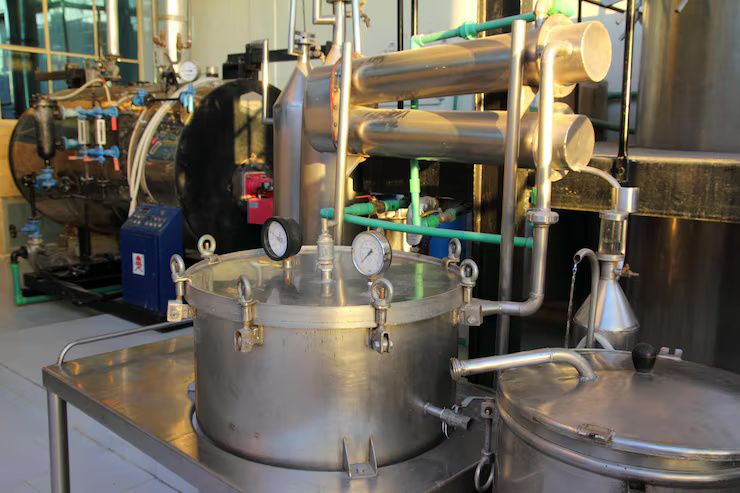
Why Industrial Distillation Equipment Matters
Distillation is one of the most established separation technologies used in process industries. It enables manufacturers to separate components from liquid mixtures and recover products at specified purity levels.
Industrial systems can be designed for continuous or batch operation. Continuous systems are commonly used for large-volume production, while batch systems can be suitable for smaller production runs, specialty chemicals, pharmaceuticals, and products that require flexible processing.
Key factors influencing equipment selection include:
- Feed composition
- Required product purity
- Production capacity
- Operating pressure
- Temperature range
- Relative volatility
- Heat requirements
- Corrosion characteristics
- Materials of construction
- Energy efficiency
Industrial Distillation Technologies
Different distillation technologies are selected according to the properties of the mixture and the desired separation.
Simple Distillation
Simple distillation is suitable when components have sufficiently different volatilities or when the objective is relatively straightforward separation.
The feed is heated, the more volatile component preferentially enters the vapor phase, and the vapor is subsequently condensed.
Fractional Distillation
Fractional distillation provides repeated vapor-liquid contact inside a column, allowing more effective separation of components with closer boiling points.
Industrial fractional distillation columns commonly use trays or structured/random packing to increase contact between rising vapor and descending liquid.
Vacuum Distillation
Vacuum distillation operates at reduced pressure. Lower pressure reduces the boiling temperature of many substances, making the technology useful for heat-sensitive materials or compounds with high normal boiling temperatures.
It is widely associated with petroleum refining, specialty chemicals, pharmaceuticals, and other applications where reduced-temperature processing is advantageous.
Steam Distillation
Steam distillation introduces steam into the process to assist in separating temperature-sensitive or high-boiling compounds.
It can be used in applications involving essential oils, fragrances, natural products, and certain chemical processing operations.
Batch Distillation
In batch distillation, a predetermined quantity of feed is charged into the system and processed through a distillation cycle.
The approach provides flexibility when multiple products or changing feed compositions must be handled using the same equipment.
Continuous Distillation
Continuous distillation continuously introduces feed into the column while products are continuously withdrawn.
It is widely used for large-scale industrial production where stable feed conditions and high throughput justify a continuous process configuration.
Major Types of Industrial Distillation Equipment
A distillation plant is normally composed of several interconnected equipment categories.
| Equipment Type | Main Function | Typical Role |
|---|---|---|
| Distillation Column | Provides vapor-liquid contact | Main separation vessel |
| Tray Column | Uses trays for vapor-liquid contact | Fractional separation |
| Packed Column | Uses packing material | Separation and mass transfer |
| Reboiler | Supplies heat to the column | Generates vapor |
| Condenser | Removes heat from vapor | Produces liquid condensate |
| Reflux Drum | Collects condensed overhead product | Reflux and product handling |
| Feed Heat Exchanger | Transfers heat between streams | Energy integration |
| Reflux Pump | Circulates liquid reflux | Column operation |
| Receiver Tank | Collects separated product | Product handling |
| Vacuum System | Reduces operating pressure | Vacuum distillation |
| Control System | Monitors operating conditions | Process automation |
Distillation Column Design
The distillation column is the central component of many industrial distillation systems.
Inside the column, vapor generally travels upward while liquid flows downward. Contact between these phases allows more volatile components to preferentially transfer into the vapor phase while less volatile components become concentrated in the liquid phase.
Tray Columns
Tray columns contain horizontal plates or trays that create repeated vapor-liquid contact stages.
Common tray designs include:
- Sieve trays
- Valve trays
- Bubble-cap trays
The appropriate tray design depends on factors such as vapor and liquid flow rates, pressure drop, fouling potential, operating range, and separation requirements.
Packed Columns
Packed columns contain structured or random packing that provides a large surface area for vapor-liquid interaction.
Packing can be advantageous when low pressure drop is important or when the process involves vacuum operation. Material selection depends on temperature, chemistry, mechanical requirements, and other operating conditions.
Industrial Distillation Manufacturing Process
Manufacturing industrial distillation equipment generally involves engineering, material selection, fabrication, assembly, inspection, testing, and commissioning.
A simplified equipment manufacturing sequence includes:
Process Design → Engineering → Material Selection → Component Fabrication → Welding and Assembly → Surface Treatment → Inspection → Testing → Documentation → Installation and Commissioning
For pressure-containing equipment, fabrication and inspection requirements can be governed by applicable codes and standards. The exact requirements depend on equipment type, operating conditions, jurisdiction, and application.
Reboilers and Condensers
The reboiler and condenser are essential heat-transfer components in many distillation systems.
Reboiler
A reboiler provides the heat required to generate vapor from the liquid collected at the bottom of the column.
Common configurations include:
- Kettle reboilers
- Thermosiphon reboilers
- Forced-circulation reboilers
Selection depends on fluid properties, circulation behavior, fouling characteristics, heat-transfer requirements, and process configuration.
Condenser
A condenser cools overhead vapor and converts it into liquid. Part of this liquid may be returned to the column as reflux while the remaining portion becomes an overhead product.
Air-cooled and water-cooled heat exchangers are among the configurations used in industrial systems.
Automation and Process Control
Modern distillation plants rely heavily on instrumentation and control systems.
Important process variables can include:
- Temperature
- Pressure
- Flow rate
- Liquid level
- Reflux rate
- Reboiler duty
- Condenser duty
- Product composition
Automated control can help maintain stable operating conditions while coordinating pumps, valves, heat exchangers, and other equipment.
Advanced process-control systems may also use online analytical measurements and predictive control strategies where appropriate.
Global Industrial Distillation Equipment Manufacturers and Suppliers
The global market includes engineering companies and equipment manufacturers that provide distillation columns, separation systems, heat-transfer equipment, complete process plants, and related technologies.
Sulzer provides separation technologies including distillation and structured packing solutions for industrial applications.
Koch-Glitsch supplies mass-transfer equipment and technologies used in industrial separation processes, including distillation columns and internals.
Alfa Laval provides heat-transfer and separation technologies that can form part of industrial process systems.
Büchler Technologies and other specialized engineering companies also participate in distillation and process-equipment markets.
The appropriate supplier depends on the process chemistry, required capacity, separation specification, operating pressure, materials, applicable standards, and project requirements.
Industrial Applications of Distillation Equipment
Distillation is used across a wide range of industries.
Chemical Manufacturing
Chemical plants use distillation for solvent recovery, purification, separation of chemical intermediates, and product finishing.
Petrochemical Processing
Refineries and petrochemical facilities use large-scale distillation systems to separate hydrocarbon mixtures into different fractions.
Pharmaceutical Manufacturing
Pharmaceutical processes can use distillation for solvent recovery, purification, and preparation of process materials.
Food and Beverage
Distillation is used in selected food and beverage processes, including alcohol production, flavor and aroma processing, and ingredient purification.
Biofuel Production
Distillation can separate and concentrate ethanol and other components in biofuel-processing operations.
Essential Oils and Fragrances
Steam and vacuum distillation technologies can be used to recover volatile compounds from botanical materials.
How to Select Industrial Distillation Equipment
Equipment selection should begin with the process requirements rather than the equipment itself.
1. Analyze the Feed
Determine composition, flow rate, contaminants, volatility, viscosity, thermal sensitivity, and potential fouling characteristics.
2. Define Product Specifications
Establish the required purity, recovery, composition, and product flow rates for each outlet stream.
3. Determine Operating Pressure
Atmospheric, vacuum, or pressurized operation can significantly influence column design, temperatures, condenser requirements, and materials.
4. Select Column Internals
Choose trays or packing according to separation requirements, pressure drop, liquid and vapor loading, fouling risk, and operating range.
5. Evaluate Heat Integration
Reboiler and condenser duties can have a major influence on energy consumption. Heat recovery and process integration may improve overall system efficiency.
6. Consider Materials of Construction
Material selection should account for corrosion, temperature, pressure, chemical compatibility, mechanical strength, and applicable standards.
Industrial Distillation Equipment Cost and Pricing Factors
The industrial distillation equipment cost can vary substantially according to capacity, column dimensions, materials, pressure rating, internals, heat-transfer equipment, automation, and project complexity.
A laboratory or small batch system is fundamentally different from a large continuous distillation plant.
Pricing can be influenced by:
- Column diameter and height
- Tray or packing configuration
- Material of construction
- Reboiler size
- Condenser capacity
- Pumps and instrumentation
- Vacuum equipment
- Automation requirements
- Fabrication standards
- Installation requirements
- Engineering and commissioning scope
For this reason, equipment comparisons should consider the complete system configuration rather than a single equipment price.
Best Practices for Distillation Systems
Proper engineering and operation are essential for maintaining stable distillation performance.
- Establish accurate feed and product specifications.
- Monitor pressure and temperature throughout the column.
- Maintain appropriate reflux and reboiler conditions.
- Inspect heat-transfer equipment for fouling.
- Evaluate corrosion and material compatibility.
- Maintain control valves, pumps, and instrumentation.
- Follow applicable pressure-vessel and process-safety requirements.
- Review energy consumption and heat-integration opportunities.
- Maintain appropriate operating procedures and emergency controls.
Frequently Asked Questions
What is industrial distillation equipment?
Industrial distillation equipment consists of columns, reboilers, condensers, pumps, receivers, heat exchangers, controls, and related components used to separate liquid mixtures based on differences in volatility.
What are the main types of distillation equipment?
Major equipment categories include tray columns, packed columns, reboilers, condensers, reflux drums, pumps, heat exchangers, vacuum systems, and process-control equipment.
What is an industrial distillation column?
An industrial distillation column is a process vessel where rising vapor and descending liquid interact to separate components according to their relative volatility.
What is the difference between batch and continuous distillation?
Batch distillation processes a defined quantity of feed during a cycle, while continuous distillation continuously feeds material into the column and continuously withdraws product streams.
How do I choose industrial distillation equipment?
Start with the feed composition, required product purity, throughput, operating pressure, temperature, separation difficulty, material compatibility, energy requirements, and applicable engineering standards.
Conclusion
Industrial distillation equipment provides controlled separation of liquid mixtures across chemical, petrochemical, pharmaceutical, food, beverage, biofuel, and specialty-process applications. A complete system can combine distillation columns, trays or packing, reboilers, condensers, pumps, heat exchangers, vacuum equipment, instrumentation, and automation.
The appropriate configuration depends on the feed, desired products, throughput, volatility, pressure, temperature, materials, and energy requirements. Careful process engineering and equipment selection are therefore essential when developing or upgrading an industrial distillation system.