
Crude oil doesn't come out of the ground ready to power your car or heat your home. It goes through a long, carefully engineered process inside a refinery before it becomes usable fuel, plastic, or chemical feedstock. That transformation depends on a network of highly specialized equipment working together around the clock.
If you've ever driven past a refinery and seen those tall towers, tangled pipes, and giant metal tanks, you've probably wondered what each piece actually does. In this article, we'll break down the core equipment used in oil refining, how each component works, and where this machinery shows up across different industrial applications.
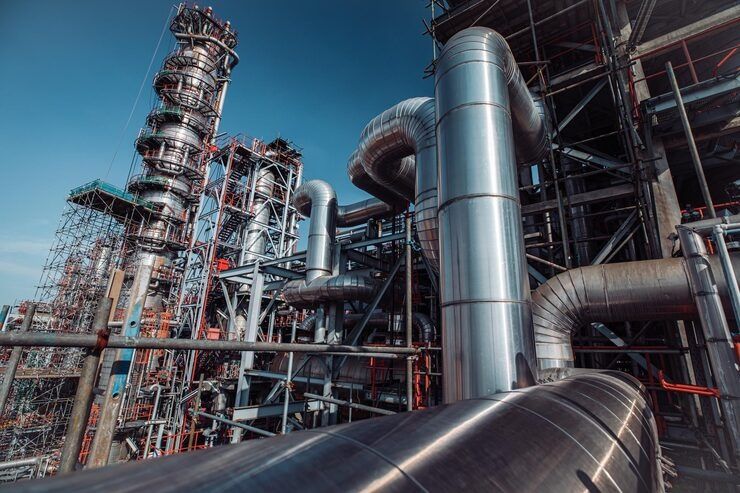
What Is Oil Refinery Equipment?
Oil refinery equipment refers to the machines, vessels, and systems used to separate, convert, and treat crude oil into usable products like gasoline, diesel, jet fuel, and petrochemical raw materials. Refining is a multi-stage process, and each stage needs equipment built to handle extreme heat, high pressure, and often corrosive materials.
Because refineries operate continuously, this equipment is engineered for durability, precision, and safety. A single malfunction can disrupt production for days, so reliability isn't optional, it's essential.
The main categories of refinery equipment include:
- Distillation units
- Heat exchangers
- Pressure vessels
- Reactors and catalytic converters
- Storage tanks and piping systems
Let's go through the most important ones in detail.
Distillation Units: The Heart of Refining
Distillation is the first and most fundamental step in oil refining. It separates crude oil into different fractions based on boiling points.
How Distillation Units Work
Crude oil is heated in a furnace and pumped into a tall structure called a distillation column. As the oil rises through the column, different components evaporate and condense at different heights, depending on their boiling points.
- Lighter fractions like gasoline and liquefied petroleum gas rise to the top
- Middle fractions like diesel and kerosene settle in the center
- Heavier fractions like fuel oil and bitumen collect near the bottom
Types of Distillation Units
- Atmospheric distillation units – Operate at normal pressure and separate the majority of crude oil components
- Vacuum distillation units – Process the heavier leftover material under reduced pressure to extract additional usable fractions without overheating the oil
Think of distillation like sorting different sized items by shaking them through a stack of sieves. Each fraction naturally settles where it belongs based on its properties.
Heat Exchangers: Managing Temperature Efficiently
Refining involves constant heating and cooling of massive volumes of liquid. Heat exchangers make this process efficient by transferring heat between two fluids without letting them mix.
Why Heat Exchangers Matter
Instead of wasting energy by heating incoming crude oil from scratch, refineries often use the heat from already-processed hot streams to warm up incoming feed. This significantly reduces energy demand.
Common Types of Heat Exchangers
- Shell and tube heat exchangers – The most widely used type, consisting of a bundle of tubes inside a larger shell
- Plate heat exchangers – Use thin plates stacked together for compact and efficient heat transfer
- Air-cooled heat exchangers – Use fans instead of water to cool hot process streams, useful in water-scarce locations
A simple real-life comparison: it's similar to a car radiator, transferring heat away from the engine to keep it from overheating, except on a massive industrial scale.
Pressure Vessels: Handling Extreme Conditions
Many refining processes happen under high pressure, which requires specially engineered containers known as pressure vessels.
What Makes Pressure Vessels Different
Unlike ordinary tanks, pressure vessels are built with thick, reinforced walls to safely contain gases or liquids at pressures far beyond atmospheric levels. They're designed and tested according to strict engineering standards because failure under pressure can be extremely dangerous.
Common Applications of Pressure Vessels in Refineries
- Reactors – Where chemical reactions occur under controlled pressure and temperature
- Separators – Used to divide gas, oil, and water streams
- Storage spheres – Hold pressurized gases like propane and butane safely
Pressure vessels essentially act like reinforced containers, similar to how a pressure cooker withstands internal steam pressure, just built on an industrial scale with far more rigorous safety engineering.
Reactors and Catalytic Converters
Beyond simple separation, refineries also chemically transform crude oil components to produce higher-value products.
- Catalytic crackers – Break down heavy hydrocarbon molecules into lighter, more valuable products like gasoline
- Hydrotreaters – Remove sulfur and impurities from fuel to meet environmental regulations
- Reformers – Improve the octane rating of gasoline by rearranging molecular structures
This is where crude oil truly becomes valuable. A barrel of raw crude might yield mostly low-value heavy oil without these units, but catalytic processing converts a much larger share into usable, higher-demand fuels.
Storage Tanks and Piping Systems
Once refined, products need to be stored and moved safely and efficiently.
- Fixed roof tanks – Store less volatile products
- Floating roof tanks – Reduce vapor loss for more volatile liquids like gasoline
- Pipeline networks – Transport crude oil, intermediate products, and finished fuels between different sections of the refinery
Without a well-organized storage and piping system, even the most advanced processing equipment wouldn't function smoothly, since materials need to move continuously between units.
Industrial Applications of Refinery Equipment
While refineries are the most obvious application, similar equipment plays a role across several other industries.
Petrochemical Manufacturing
Distillation columns, reactors, and heat exchangers are also used to produce plastics, synthetic rubber, and industrial chemicals from refined feedstock.
Power Generation
Heat exchangers and pressure vessels are common in power plants, particularly in steam-based electricity generation systems.
Natural Gas Processing
Similar separation and pressure vessel technology is used to purify natural gas before distribution.
Marine and Shipping Fuel Production
Refineries produce specialized marine fuels, requiring precise blending and quality control through similar processing equipment.
Chemical and Fertilizer Industries
Reactors and pressure vessels used in refining share design principles with equipment used to manufacture industrial chemicals and fertilizers.
Why This Equipment Requires Careful Engineering
Refinery equipment isn't just about moving liquid from one place to another. It has to withstand:
- Extremely high temperatures
- Intense internal pressure
- Corrosive chemical exposure
- Continuous, uninterrupted operation for months or years at a time
Because of these demanding conditions, refinery equipment goes through rigorous testing, inspection, and maintenance schedules. Even small design flaws can lead to major safety risks or unplanned shutdowns, so precision engineering is non-negotiable.
Final Thoughts
Oil refinery equipment might not be something most people think about daily, but it plays a massive role in producing the fuels and materials modern life depends on. From distillation units separating crude oil into usable fractions, to heat exchangers managing energy efficiently, to pressure vessels safely containing extreme conditions, each component plays a specific and essential part in the process.
Understanding how this equipment works gives valuable insight into just how complex and precisely engineered the refining process really is, and why reliability and safety remain top priorities across the entire industry.