
Industrial heat exchangers and heat recovery systems help factories transfer thermal energy between fluids, capture waste heat, and improve energy efficiency. These technologies are widely used in power generation, chemical processing, oil and gas, food production, pharmaceuticals, and manufacturing plants.
Heat exchangers generally transfer heat without allowing the fluids to mix directly. In many designs, a solid metal surface separates the fluids, allowing thermal energy to pass through the material. Other designs bring the fluids into direct contact when the process allows it.
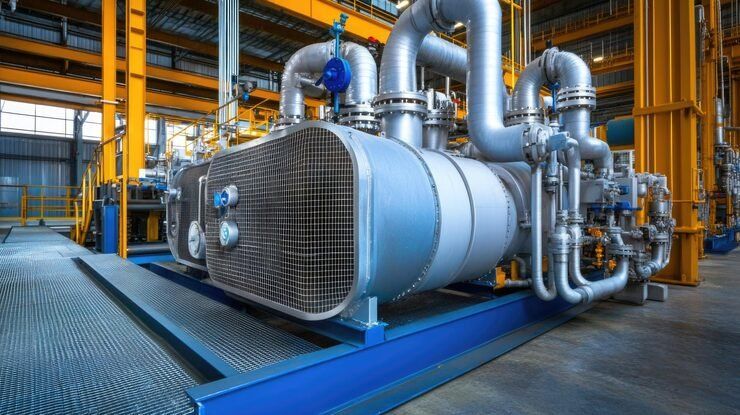
Heat transfer is important because many industrial processes require controlled temperatures. Raw materials may need heating before processing, while machinery, chemical reactions, and finished products may require cooling. Industrial heat recovery systems help reuse available thermal energy in another part of the process.
How industrial heat exchangers work
Heat naturally moves from a hotter region toward a cooler region. A heat exchanger uses this principle to transfer thermal energy between streams at different temperatures. The amount of heat transferred depends on factors such as temperature difference, fluid flow, heat-transfer surface area, material properties, and equipment design.
Three heat-transfer mechanisms are relevant:
Conduction: Heat passes through a solid material, such as the metal wall separating two fluids.
Convection: Heat moves between a fluid and a surface as the fluid flows across it.
Radiation: Thermal energy travels through electromagnetic waves and can become important in high-temperature furnaces and certain specialized systems.
Most conventional industrial heat exchangers rely primarily on conduction through separating surfaces and convection between those surfaces and the fluids.
Main types of industrial heat exchangers
Different equipment designs suit different temperatures, pressures, fluids, and operating conditions.
Shell-and-tube heat exchangers: Contain tubes enclosed within a larger shell. One fluid flows through the tubes while another flows around them. These units are common in refineries, chemical plants, and power generation.
Plate heat exchangers: Use a series of thin plates to create channels for alternating fluid streams. Their compact structure makes them useful in food processing, HVAC systems, and industrial cooling.
Air-cooled heat exchangers: Transfer heat from a process fluid to ambient air, often using fans and finned tubes. They are useful where cooling water is limited or undesirable.
Double-pipe heat exchangers: Use one pipe inside another, with separate fluid paths. They are suitable for some smaller processes and specialized operating conditions.
Spiral heat exchangers: Use spiral-shaped flow passages and can handle certain viscous fluids or streams containing suspended material.
Condensers and evaporators: Transfer heat during phase changes, such as when vapor condenses into liquid or liquid evaporates into vapor.
The appropriate design depends on the process rather than the equipment name alone. Engineers consider thermal performance, pressure limits, maintenance access, corrosion resistance, and the likelihood of deposits forming on heat-transfer surfaces.
Importance
Industrial heat exchangers play an important role in energy management, process stability, and equipment protection. Many industrial operations generate heat as a natural part of production. Without suitable cooling or heat recovery arrangements, this energy may be discharged into the environment even when another process requires heating.
Heat recovery can reduce the need to generate the same amount of thermal energy from a separate source. For example, hot exhaust gases from a furnace may preheat incoming combustion air, or warm process water may be used to heat another incoming stream. The practical results depend on the available heat, temperature requirements, equipment performance, and operating schedule.
Industrial applications of heat exchangers
Heat exchangers are used across a wide range of industries.
Oil and gas: Cool process fluids, condense vapors, and transfer heat between streams during refining and gas processing.
Chemical manufacturing: Control reaction temperatures, heat raw materials, and recover thermal energy from process streams.
Power generation: Condense steam, cool circulating water, and transfer heat within thermal power systems.
Food and beverage processing: Heat or cool liquids, support pasteurization, and maintain required processing temperatures.
Pharmaceutical manufacturing: Control temperatures in production vessels, process liquids, and certain clean manufacturing environments.
Metal processing: Cool industrial equipment, recover furnace heat, and regulate temperatures during thermal treatment.
HVAC and refrigeration: Transfer heat between refrigerants, water, air, and other working fluids.
Pulp and paper manufacturing: Recover heat from process water, steam condensate, and other warm production streams.
Benefits of industrial heat recovery
Heat recovery can improve how a facility uses its available energy. The main benefits depend on the type of process and the amount of recoverable thermal energy.
Reduced energy demand: Recovered heat may replace part of the energy otherwise required for heating.
Improved process control: Heat exchangers help maintain operating temperatures within defined ranges.
Lower thermal discharge: Reusing heat may reduce the amount of waste heat released into cooling water or the atmosphere.
Equipment protection: Suitable cooling systems help prevent excessive temperatures that can damage machinery or affect product quality.
Resource efficiency: Heat recovery can reduce demand for heating fuels, steam generation, or other energy inputs.
However, a heat exchanger does not generate energy. Its performance depends on the available temperature difference and the energy required to move fluids through the system. Pumps, fans, cleaning requirements, and pressure losses also affect overall performance.
Heat recovery methods used in industry
Several arrangements are used to capture and reuse thermal energy.
Waste heat recovery: Collects heat from exhaust gases, hot liquids, or other process streams and transfers it to a useful application.
Heat integration: Coordinates heating and cooling requirements across several processes so that heat released by one operation can support another.
Heat pumps: Use additional energy to move heat from a lower-temperature source to a higher-temperature application. Industrial heat pumps can recover low-temperature heat that may not be directly useful for the intended process.
Regenerative heat recovery: Uses a thermal storage material or structure that absorbs heat from one stream and releases it to another stream during a different part of the operating cycle.
The suitability of each method depends on temperature levels, process timing, fluid characteristics, and the required output temperature.
Recent Updates
Industrial heat exchanger technology continues to develop in response to energy efficiency requirements, industrial electrification, digital monitoring, and changing manufacturing processes. Developments from 2024 through 2026 have emphasized better system integration, condition monitoring, and the use of recovered heat in applications that previously relied on separate heating equipment.
Advances in heat transfer technology
Manufacturers and engineering teams continue to examine compact heat exchangers, improved surface designs, and materials suited to demanding temperatures or corrosive environments. Plate-based and microchannel designs can provide substantial heat-transfer area within a relatively small space, although their suitability depends on pressure, fluid cleanliness, and maintenance requirements.
High-temperature heat recovery is also relevant to furnaces, cement production, metal processing, and other energy-intensive operations. Specialized recuperators, waste heat boilers, and thermal storage systems can capture energy from hot exhaust streams. The equipment must be designed around the exhaust temperature, chemical composition, dust levels, and potential corrosion risks.
Industrial heat pumps are receiving increased attention as manufacturers explore electrification and the reuse of low-temperature heat. Their practical performance depends on the temperature lift required, the electricity supply, the heat source, and the operating conditions.
Digital monitoring and predictive maintenance
Connected sensors and industrial monitoring systems can track temperatures, pressure differences, fluid flow, and equipment vibration. These measurements help operators identify changing performance and investigate potential problems.
Predictive maintenance software can analyze operating data to detect patterns associated with fouling, leakage, reduced flow, or mechanical deterioration. However, software alerts do not replace physical inspections, appropriate testing, or qualified engineering assessments.
Materials and environmental considerations
Material selection remains an important area of development. Stainless steel, titanium, copper alloys, nickel alloys, and other specialized materials may be selected according to the fluids, pressure, temperature, and corrosion conditions involved.
Engineers are also considering how heat recovery fits into broader industrial decarbonization plans. Recovering thermal energy may reduce fuel consumption, but the overall environmental effect depends on the original energy source, additional electricity use, equipment manufacturing, and the way recovered heat is utilized.
Laws or Policies
Industrial heat exchangers are affected by regulations and standards relating to pressure equipment, workplace safety, industrial emissions, electrical systems, and environmental protection. Requirements vary according to the equipment's operating pressure, temperature, location, fluid type, and intended application.
Regulatory considerations in India
In India, industrial facilities must consider applicable factory safety requirements, pressure equipment rules, environmental regulations, and relevant technical standards. Heat exchangers used as pressure vessels or boilers may fall under specific regulatory requirements depending on their design and operating conditions.
The Boilers Act, 2025, and associated rules are relevant to regulated boilers and related equipment within their applicable scope. Not every heat exchanger is legally classified as a boiler, so the equipment's construction and intended function must be considered separately. Facilities should verify the applicable provisions, notifications, and technical requirements with the relevant authorities.
Environmental requirements may also apply when heat recovery systems affect industrial emissions, cooling-water discharge, or energy consumption. The precise obligations depend on the industry, facility location, and applicable approvals.
International standards and technical codes
Several established standards and codes are relevant to heat exchanger design, construction, inspection, and operation.
ASME Boiler and Pressure Vessel Code: Covers requirements for specified pressure equipment, including applicable construction and inspection provisions.
TEMA standards: Provide technical guidance for shell-and-tube heat exchanger design and related construction practices.
API 660: Addresses shell-and-tube heat exchangers used in petroleum and related processing industries.
ISO 9001: Covers quality management systems that may be relevant to equipment manufacturing and production control.
ISO 50001: Provides a framework for energy management, including systematic evaluation of energy performance.
These standards do not automatically apply to every installation. Their relevance depends on jurisdictional requirements, contractual specifications, equipment classification, and industry practices.
Tools and Resources
Industrial heat exchanger selection and operation involve thermal calculations, mechanical design, material evaluation, and ongoing performance monitoring. Engineers use a combination of software, reference documents, and measurement tools to assess these requirements.
Common engineering tools
Thermal design software: Helps engineers estimate heat-transfer duty, required surface area, fluid temperatures, and pressure losses under specified operating conditions.
Computational fluid dynamics (CFD): Models fluid flow and heat transfer to examine temperature distribution, turbulence, and potential flow restrictions.
Process simulation software: Represents connected industrial processes to evaluate heating requirements, cooling loads, and opportunities for heat integration.
Temperature and pressure instruments: Measure operating conditions and help identify changes that may indicate fouling, flow restrictions, or equipment malfunction.
Energy monitoring systems: Track energy consumption, thermal loads, and operating patterns across production equipment.
Information needed for heat exchanger selection
An initial technical assessment commonly considers the following information:
Fluid composition, flow rate, and operating temperatures.
Required heat duty and target outlet temperatures.
Operating and design pressures.
Corrosion potential, fouling tendency, and fluid cleanliness.
Available installation space and maintenance access.
Applicable safety requirements and inspection intervals.
Manufacturing processes also influence equipment performance. Common production activities include tube forming, plate pressing, welding, brazing, machining, surface treatment, assembly, and pressure or leak testing. The exact sequence depends on the exchanger design and materials.
FAQs
What is an industrial heat exchanger used for?
An industrial heat exchanger transfers thermal energy between fluids or between a fluid and another medium. It is used for heating, cooling, condensation, evaporation, and heat recovery across manufacturing and processing industries.
What are the main types of industrial heat exchangers?
Common types include shell-and-tube, plate, air-cooled, double-pipe, and spiral heat exchangers. Condensers and evaporators are also widely used where heat transfer accompanies a change in fluid phase.
How does an industrial waste heat recovery system work?
A waste heat recovery system captures thermal energy from a source such as hot exhaust gas, steam condensate, or process water. The recovered heat is then transferred to another process or used through a suitable heat pump or thermal storage arrangement.
Which materials are used in heat exchanger manufacturing?
Common materials include stainless steel, carbon steel, copper alloys, titanium, and specialized nickel alloys. Material selection depends on temperature, pressure, fluid chemistry, corrosion resistance, and applicable engineering requirements.
How can heat exchanger performance be monitored?
Performance can be assessed by measuring inlet and outlet temperatures, fluid flow rates, pressure drops, and energy transfer. Changes in these readings may indicate fouling, leakage, flow restrictions, or other operating problems that require further investigation.
Conclusion
Industrial heat exchangers transfer thermal energy for heating, cooling, and process temperature control across numerous industries. Heat recovery technologies help reuse thermal energy that would otherwise be discarded, supporting more efficient industrial operations when conditions are suitable. Equipment selection depends on fluid properties, operating temperatures, pressure requirements, materials, maintenance needs, and applicable regulations. Advances in digital monitoring, heat pumps, and compact heat-transfer designs continue to influence industrial thermal management.